Showing posts with label biology. Show all posts

Wednesday, 7 August 2013

Zombies - Sick Zombies

Greetings Zombiology Students and a hearty welcome to the ZomBlog.

Today’s question came in from John, he asked ‘can Zombies get sick?’


Regular readers will know that our version of Zombies here at the Institute are based on genuine science, rather than fiction. So there are many differences between our idea of a Zombie and those you might encounter on the silver screen.

Presently it is not possible to have a dead body that acts as though it were living. Our current theories dictate that Zombies are not undead but they are human beings who are suffering from a disease. Therefore they will still have beating hearts, a need to eat, breathe and expel waste. The Zombie disease will cause them to be very aggressive, eating continually (controversially not just human flesh - but anything), walk with unsteady shambling movements, and communicate only through a deathly moan. Whatever causes this disease, be it a virus, bacterium, or prion disease, it will be a serious, horrific illness.

The cat based meme is also a strong contender. 
But as John asks, could Zombies get sick?

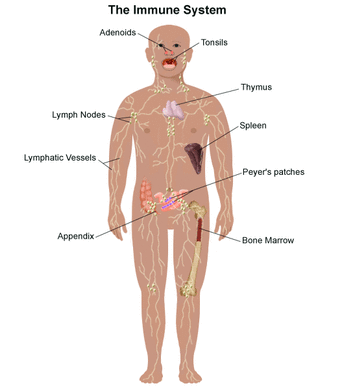
All of us have a guardian against getting ill, our immune system. The immune system is our defender from infectious invaders. Through something called an immune response, the immune system attacks organisms and substances that enter our body to try and damage our vital systems or cause disease.
The immune system, as portrayed by a terrifying drawing.
A network of cells, tissues and organs make up the immune system. The important cells are the white blood cells, also known as leukocytes. They come in two basic types; phagocytes, which, much like a Zombie, chew up invading organisms, and lymphocytes, cells that allow the body to remember and recognize previous invaders and help the body destroy them.
When foreign substances enter our body (called antigens), many cells work together to spot them, and try to get rid of them. They do this by triggering the creation of antibodies, special proteins that lock on to the invaders. Once they’ve been created, they stay in the body, ready to strike again should the disease return. This is why once you get sick with something like chicken pox it is unlikely you’ll get ill from it again.
There are diseases that can affect the immune system. One of the most well known is HIV (human immunodeficiency virus) infection / AIDS (acquired immunodeficiency syndrome). This disease gradually destroys the immune system. Without any defence the body is vulnerable to a multitude of organisms which can easily cause life threatening infections in AIDS patients.
Whatever is causing Zombieism it will be a very invasive disease and is likely to weaken the immune system. On top of this a Zombie’s diet is unlikely to be balanced. They are simply eating anything and everything they can. It is doubtful they’ll be garnishing all the required nutrients that help the body fight off germs. Poor hygiene will also play a role. After all I seriously doubt that a Zombie will take the time to wash its hands after eating or going to the bathroom (if indeed they go to a bathroom, they probably go wherever and whenever they want).
I believe they call this a 'mercy flush'.
Combining all these factors together and a Zombie is going to be an easy target for every illness out there. So the answer to John’s question, can Zombies get sick, has got to be a firm yes. Not only can they get sick, they’re at much greater risk than the rest of us. Hence biological warfare may offer a defence against the apocalypse. But here at the Zombie Institute we always recommend trying to help treat and cure Zombies, rather than trying to kill them! Always remember that Zombies are people too.
If you have a question about the undead please get in touch with me in the comments section below, and don’t forget to visit our Book of Faces (www.facebook.com/zombiescience). I’m ready, waiting, and willing to answer your questions right here on the ZomBlog.

Stay safe students,

Doctor Austin

Doctor Austin ZITS BSz MSz DPep, is a Theoretical Zombiologist and Head of the Zombie Institute for Theoretical Studies at the University of Glasgow, Scotland UK.


Monday, 4 February 2013

Are Zombies Real?

A warm welcome to all of you fine Zombiology Students.

As I travel the UK delivering our new tutorial Zombie Science: Worst Case Scenario I find myself regularly being asked one question in particular, ‘are Zombies real?’

Whilst this question may seem to evoke a simple yes or no answer, it is actually a little more complicated than that.


I hope it's a yes, otherwise I'll be looking pretty stupid right now...
Certainly the Zombies (dead human bodies reanimated with an unending desire to consume flesh and the ability to transform those they bite) that populate the world of television, films, comics and games do not presently exist in the real world.

However that doesn’t preclude them from ever existing. There are many agents capable of causing disease including viruses, bacteria, parasites and rogue prions. Whilst none of these produce all the symptoms found in a fictional Zombie it is important to remember that these agents are always changing.

Think for a moment of the flu. We’ve all had it at least once, but it’s far more likely you’ve had it several times. It is caused by the influenza virus, and like Lady Gaga it’s always changing. As with all living things the virus makes small mistakes, called mutations, each time it reproduces. In every generation there are slight differences and overtime these differences build up. The fancy term for this process in ‘antigenic drift’ and this is why scientists have to continually update and change flu vaccines, to try and keep up with changes in the virus.


From this example we can see how a virus can change. Who is to say that at some point in the future a virus might change enough to produce an illness that matches the fictional version of Zombieism?

Now remember, I said this wasn’t a simple question.

Zombies are real and do exist, there’s even a law banning them from being created – although they’re not like those you’ve seen on the silver screen.

Don’t believe me? Then let’s travel to the Caribbean country of Haiti, as ethnobotanist Wade Davis did over 25 years ago. Here we find a deeply spiritual culture with a deep belief in the existence of Zombies – albeit far from the Zombies of Romero or Kirkman.

Let’s say you’re Haitian and you’ve got a family dispute. Perhaps your brother borrowed your wife, or your Gran keeps asking you to explain the internet – how do you resolve it? Simple, get the local sorcerer to turn them into a Zombie slave – problem solved!
To the Bingo? Eh, yeah, of course we are Gran.
That’s precisely what is believed to have occurred there as Wade Davis discovered. Through meetings with these sorcerers (known as Bokors) Davis managed to acquire samples of their Zombie powder. Analysis revealed the presence of a range of substances including one in particular; Tetrodotoxin. Found in species of puffer fish this toxin is one of the deadliest poisons known to humanity. However if administered in small doses it doesn’t cause death but rather gives one the appearance of being dead via paralysis, the slowing down of body functions, and the like.


Now which one is the Zombie Powder and which one is the Paprika?
The Bokor would place the Zombie powder in an unsuspecting victim’s shoes, down their back or generally anywhere where it would come in contact with the skin, nose, and throat. The victim would appear to progress toward death, eventually fooling people that they were indeed dead, and be buried.   

The Bokor and his minions would then exhume the victim and feed them another concoction designed to keep them somewhat ‘out of it’, so that they wouldn’t attempt to escape or talk back. Many claim these Zombies were then put to work as slaves, but how useful they’d be in performing even a basic task is debateable.   
As I mentioned earlier, creating a Zombie in Haiti is illegal, as article 246 of the Haitian penal code states:


It shall also be qualified as attempted murder the employment which may be made against any person of substances which, without causing actual death, produce a lethargic coma more or less prolonged. If, after the person had been buried, the act shall be considered murder no matter what result follows.

So as we have seen, ‘are Zombies real?’ is a hard question to answer, but I’ll try and make it as simple as possible. The answer is yes, and no.

If you want to know anything about the real science behind Zombies, do send your questions in to info@zombiescience.co.uk or post them in our Book of Faces (www.facebook.com/zombiescience).

Just remember to stay on good terms with your family if you ever find yourself in Haiti,

Doctor Austin

Doctor Austin ZITS BSz MSz DPep, is a Theoretical Zombiologist and Head of the Zombie Institute for Theoretical Studies at the University of Glasgow, Scotland UK.

See the Zombie Science: Worst Case Scenario tutorial –

Brighton Science Festival 2013:
Date: Sunday 10th February 2013
Times: 5.30pm & 7.30pm
Venue: Sallis Benney Theatre, 58-67 Grand Parade, Brighton, BN2 0JY
Tickets: Visit Brighton Science Festival’s Official Website 


Glasgow International Comedy Festival
Date: Monday 18th March 2013
Time: 7.30pm
Venue: The Stand Comedy Club, Woodlands Road, Glasgow, Scotland
Tickets: Visit the festival’s official website

Monday, 26 November 2012

The Walking Bred?

Good day to all you fine Zombiology Students,

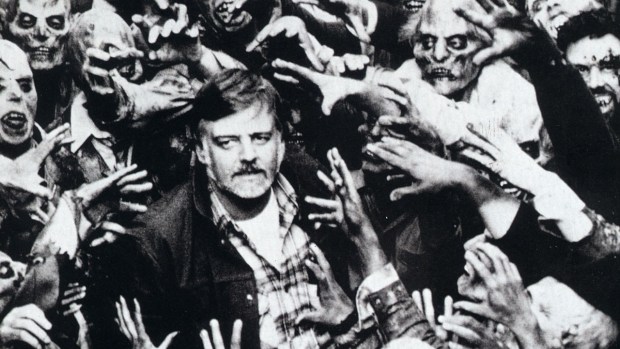
I’m sure many of you are fans of the Walking Dead¸ whether in the medium of a comic book, novel, computer game or TV series – it’s truly impossible to avoid… and why would you want to? In any form it’s become one of my favourite Zombie worlds since George Romero gave birth to the modern version.

Who wants ice cream? Daddy's buying ice cream!
Being a scientist I’m interested in what Zombieism would be like in real life, and what elements we see in fiction would actually work in reality. The Walking Dead has thrown up a few brain teasing questions that I’m keen to answer. So in today’s ZomBlog I’m going to investigate their version of Zombieism, specifically trying to figure out these two puzzles…

How is the disease being transmitted?
And.
Whether their claim that everyone has the disease, but not everyone has shown symptoms, is really possible?

Why won't you just love me?
Whether intentional or not, Walking Dead makes the clever decision of not explicitly telling us what is causing the disease, making it more fun to theorise on.

"Internally, we don't know where the zombie outbreak started, how to cure it, anything like that," – Glen Mazzara, Show Runner, Walking Dead (TV Series)

“...the rule is: WHATEVER it is that causes the zombies, is something everyone already has. If you stub your toe, get an infection and die ... you turn into a zombie." – Robert Kirkman, Creator, Walking Dead

In the TV series even a CDC disease specialist whose been studying the outbreak for months hasn’t been able to figure out the causative agent.

“It could be microbial, viral, parasitic, fungal…”                                                                                                                     – Dr. Edwin Jenner, Walking Dead, Season 1 Episode 6

Animal, vegetable, mineral ... wait ... what was the question? 
From observation we can make some assumptions about its transmission:

The disease seems to spread through saliva. People contract it after being bitten by infected people. This is much like Rabies. A Rabies infected animal has the virus in its nerves and saliva, and can transmit it to a human through biting. In rarer cases, the animal can spread the virus when its saliva comes in contact with a person's mucous membranes (moist skin surfaces, like the mouth or inner eyelids), or broken skin such as a cut, scratch, bruise or open wound.

In Walking Dead, no one appears to have been infected from indirect contact. For example, the survivors must spend a massive amount of time off camera cleaning up the biological debris left by each action scene. This would inevitably include a few litres of Walker drool. Yet never has a character turned after embarking upon a heavy session of mopping, when perhaps, in the rarest of cases they should. (Exciting idea for Season 4? No expensive make-up or effects, just a mop and 250ml of dirty drool!?!)

Rabies has never been found in blood, perhaps it’s the same with the Walking Dead Zombie disease. This would explain why, despite the characters flip-flopping between being careful to avoid contact with Zombie blood and getting splashed on like a kid at Sea World, they don’t get the illness. 

I told you, this episode we stay clean of Walker bits, next season we'll be like kids in a fountain. Visualise the fountain with me Rick. Visualise. 
Alongside the saliva based transmission we also get a shocking revelation from the only bona fide medical expert we meet in the TV series, shortly before killing himself, when he utters the terrifying line, “every survivor is infected.”

How can everyone be infected but not turn?

An interesting comparison is latent tuberculosis infection. Tuberculosis is caused by bacteria called Mycobacterium tuberculosis. Some people who are infected by it do not develop the active illness. It simply remains inactive and stays that way in the majority of cases – this is known as latent tuberculosis infection. For a small percentage of people it can eventually become active for a variety of reasons; if their immune system is damaged or compromised, if they become malnourished, or simply when they become older. So our Walking Dead characters may have latent Zombieism infection. A major biological event, such as a severe trauma, or being near death, may be what is activating it.

We've really got to stop letting the Daleks make these posters...
We’ve managed to answer both of our questions today. How is the Walking Dead Zombie disease being spread? It could be like Rabies, in the saliva of the infected Walkers. This would explain why getting covered in blood and guts doesn’t turn anyone. But realistically the characters should be equally afraid of being licked by a Walker as being bitten by one.

Finally, we discovered that it is possible for us humans to be infected by a disease that lies inactive, waiting for certain conditions to get it going. A terrifying thought, I’ll not sleep tonight! 

I do hope you enjoyed this entry, and if any of you out there want to know anything about the real science behind Zombies, do send your questions to info@zombiescience.co.uk, post them in our Book of Faces (www.facebook.com/zombiescience) or get in touch on our website www.zombiescience.co.uk.


Stay Frosty,

Doctor Austin

Doctor Austin ZITS BSz MSz DPep, is a Theoretical Zombiologist and Head of the Zombie Institute for Theoretical Studies at the University of Glasgow, Scotland UK. 


Wednesday, 13 June 2012

Face Off


Good day Zombie Science Fans,

In the past few weeks the world has been buzzing with stories of potential zombie incidents. Only last week I was on US radio reassuring my American cousin’s that they are safe, and have had many requests to explain what’s going on via the old Book of Faces.

The body of Mr. Rudy (naked) and his victim Mr. Poppo.
It all began with a chap in Miami USA, who spent almost 20 minutes eating a homeless man’s face before being shot dead by police. From there the floodgates opened, not a day passed without someone eating someone’s something, and journalists attributing it all as evidence that the zombie apocalypse is nigh.

Now, no one more than I would welcome the arrival of zombies. Mostly because if they remain theoretical I will have wasted my entire scientific career. But also because it would make it easier for our Institute to acquire research funding.

So are these incidents indicative of Zombieism spreading amongst the population?

No.

And here’s why.

Journalists regularly use the word zombie in their articles to sell more papers, zombie-banks, zombie-youth, zombie-countries, etc. In fact I’ve written about this in a previous blog. It amazes me, given what we know of the industry, that people still believe anything that’s written in a newspaper. But that’s away from the subject.

If we put zombie in the headline twice we'll sell double the amount. Throw in our integrity too. 
The three main ‘supposed zombie’ stories cited have been; Eugene Rudy AKA the Miami Cannibal, who ate up to 75% of the homeless Mr. Poppo’s face before police stopped him, the Baltimore student who murdered his housemate and ate parts of his brain and heart, and lastly, the Hackensack man who stabbed himself dozens of times and threw his protruding intestines, as well as pieces of skin, at the SWAT Team who arrived to help him.

Sack, right, not slash. My bad. Let me wipe those intestines off. Officer.
Now we can certainly understand where the zombie angle comes from for the first case, it maybe just works for the second, but certainly not the third.

In the Miami case the attacker showed no regard for wearing clothing, consumed his victim raw, did not respond when talked to, and did not demonstrate self-preservation (ignoring the officer’s request to desist or be shot). These are all behaviours a true zombie may have.

The second case is tenuous at best. The murder may or may not have been premeditated, but the keeping of the body parts most certainly was a conscious choice. Zombies do not have the mental capacity to plan or carry out such a scenario.

The third case is definitely disturbing, but hardly zombie like. A zombie would struggle to use a weapon, has little interest in self-harm, and doesn’t have the coordination to throw an object.

So if the cause isn’t Zombieism, what is it?

There are a variety of possibilities. The Miami Cannibal was thought to have been high on a designer drug called ‘bath salts’. The effects of this drug are consistent with his behaviour, high temperature (leading to removal of clothing), hallucinations, and violent behaviour. However this has not yet been corroborated by toxicology reports.

Man, I'm so high right now.
The second case was one of pure cannibalism. Cannibalism is in itself a mystery. We do not know what makes some people choose to eat other people. We have yet to identify anything in the brain, damage or otherwise, that can explain why it happens. You won’t find cannibalism in any psychiatric handbook or any instances of it being a defence for the behaviour in court.

Lastly, the third case was carried out by someone who had a history of mental problems.

In conclusion, none of these events provide us with any evidence to support the arrival of the Zombieism disease.

Many people are citing bath salts as being a drug that makes people into zombies. However there have been countless bath salt fuelled incidents reported; such as a man who broke into a random family’s house and put up their Christmas decorations, or, another man who was found wearing women’s lingerie, standing over the body of a dead goat. These tales just scratch the surface of ‘high on bath salts’ news stories. Yet it is only the ones that can be vaguely pinned on Zombieism that get the same attention as that of the Miami Cannibal.
So the next time you read something discussing a supposed incidence of Zombieism, check the source. If it has been written by a journalist and not a zombiologist and/or scientist, you may want to pass it directly to my colleague, Mr. Shredder (the appliance, not the Turtles baddie).

Ha ha Doctor Austin, I'm where all those manuscripts you send to Brian Cox end up!
If any of you out there want to know anything about the real science behind zombies, do send your questions in to info@zombiescience.co.uk or post them on our Facebook page (www.facebook.com/zombiescience).

The truth may well be out there,

Doctor Austin
Doctor Austin ZITS BSz MSz DPep, is a Theoretical Zombiologist and Head of the Zombie Institute for Theoretical Studies at the University of Glasgow, Scotland UK.
  
For even more Zombie Science pick up the official Zombie Science book on Amazon now


Wednesday, 4 April 2012

Getting a Zombie grip, and maybe a rip

Bottom of Form
Good day Zombiology Students,

The recent exciting series of the Walking Dead has inspired my students to ask a lot of new zombie questions.
Andrew, an excellent student of mine, asked me this, ‘Are zombies able to tear into someone’s guts with their bare hands? We all know they like to use their teeth but can say Granny Z (that is a zombie with no teeth) uses its hands to tear us into swallow-able pieces? We have already seen zombies have no self-preservation instinct so assuming no atrophy or other degradation of the muscle mass should we not be conscious of the fact that zombies will bring a greater strength to bear as they will not care about injuring themselves? Something any human is capable of (imagine pre-zombie granny Z lifting a car off her grandchild) under particular circumstances’.

I hope the answer is no, but I have my doubts.
Let’s start with the first part, can a human being tear apart another human being bare handed? Well yes, yes they can. As recently as October 2011 a man in Italy tore out his own eyeballs during a Church sermon, and in 2006 a man in the USA lifted a 3,000 pound car to free an injured cyclist. With practice most of us could tear a phone book in half, even if I myself have never managed it.

Success! I can't wait to call my friends, what are there numbers? Oh.
But a person suffering from our proposed Zombieism Prion Disease would be very unsteady on their feet, and have poor control over their limbs. Also, because Zombieism would be a new form of prion disease, it may incorporate the symptoms and characteristics of other current prion diseases. For example Chronic Wasting Disease (CWD), causes amongst other things, extreme weight loss. Although it affects animals at present CWD could develop into part of the new Zombieism Prion Disease. So there is a good chance Zombieism would reduce a person’s strength considerably.

With regard to self-preservation amongst zombies, we certainly see that symptom in the movies, with zombies happily walking through rotor blades on the off chance of getting a snack. In our studies we have concluded that real life zombies would feel pain. The condition congenital insensitivity to pain (CIP), which prevents sufferers feeling the signal of pain, is something one is born with. It cannot be caught like a cold. This condition is the closest comparable one we’ve found to that fictional zombie symptom. CIP is very rare, with only around 100 cases in the USA, so we can bet a real zombie is very unlikely to have that symptom.

No stinkin' helicopter rotor is getting between me and my brunch.
However we know that Zombieism causes a lot of damage to the brain. One area of the brain, the amygdala, is responsible for our instincts. Shaped like an almond, and buried deep with the temporal lobes, it produces much of not only our instincts, but our base emotions as well. If Zombieism caused damage to this area, it may produce a zombie that was overcome with instinct, so much so it may show disregard for pain, even if it was feeling it.

Finally let’s go back to those events, like Andrew’s ‘Granny lifting a car idea’, where people show moments of almost super human strength. In a dangerous situation the human body goes through some interesting changes.

I'll either lift that car, or shoot it off. 
In the brain, the hypothalamus activates, sending a chemical signal adrenal glands. These glands produce adrenalin, which is to the human body, what spinach is to Popeye. When fuelled by adrenalin our muscles are able to contract more. This suddenly gives us the ability to perform actions, like lifting a car, actions we normally couldn’t have managed. Some believe that most of time we only use a small proportion of our strength. When under threat we simply gain the ability to expand on what we already have. But these fits of strength are short lived. Within a few minutes of happening the body begins to return to a more normal state.

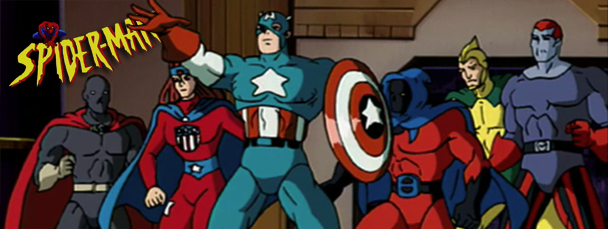
It’s a lot like those friends of Captain America, the Six American Warriors, who were given a less refined version of the super solider serum. It gave them Cap’s powers but only for a short time. Inevitably these newly found super powers would give out during a pivotal moment in the plot. On the bright side they do always return during final battles.

The Six American Warriors, well, em, I can name one...
To conclude; zombies do have the potential to tear a human apart. Like humans, when faced with a dangerous situation they may also receive an adrenalin rush, giving them a short burst of enhanced strength. However the Zombieism disease would be badly affecting their ability to move both legs & arms, and may be causing wasting of the body. So they may lack comparable strength to a healthy human.

Ultimately zombies are like fingerprints, each one is different. And just like fingerprints they inevitably end up all over your glass door. No zombie would have the exact same presentation of the disease as another, so some may be more akin to human, and others more akin to demons.

I just washed these you inconsiderate fiends! 
Thank you Andrew for a great question, and if any of you out there want to know anything about the real science behind zombies, do get in touch on info@zombiescience.co.uk.

Best wishes,

Doctor Austin
Doctor Austin ZITS BSz MSz DPep, is a Theoretical Zombiologist and Head of the Zombie Institute for Theoretical Studies at the University of Glasgow, Scotland UK.  

For even more Zombie Science pick up the official Zombie Science book on Amazon now

Wednesday, 8 February 2012

A Tale of Two Zombies

Hello Zombiology Students,

We recently received two interesting questions from you Zombiology fans and decided to share them in today’s ZomBlog.

The first is from Vicki who emailed asking ‘would it be possible for zombies to be made from a natural mutation of a dual-infection? My idea is that the fer-de-lance snake and a vampire bat causing rabies, both in Panama, could both infect someone, possibly mutate and cause a zombie apocalypse.’

The Bothrops atrox aka fer-de-lance, is a venomous snake, ‘regarded as the most dangerous snake in the Panamanian jungles, chiefly because it is the commonest of the vipers’ (Elton 1999). The snake bite releases venom which contains a substance called a haemotoxin.  In the human body this kills red blood cells, stops blood clots forming and can cause tissue damage.    
Fig 47# Fer-de-lance (with snake)
Vampire bats can refer to three species of bat whose diet consists of blood. Contrary to popular belief they do not suck blood through their teeth, but rather create a wound and lap the blood up. As with all bats they have the possibility of transmitting Rabies, however in reality only a small percentage of the population carry it.
Fig 420# The Vampire Bat (aha ha, gosh I pee'd a little there)
Now we know some basics let’s turn to our resident viral expert, Dr. Katie White for more details, ‘the damage caused by fer-de-lance snake bite isn’t caused by an infection.  Infections are caused by the presence or growth of a biological agent (e.g. bacteria, virus) within the host body.  As an infectious agent grows and multiplies within the host body, the host can then pass on the infection to other people/animals.  The snake venom is not an infectious agent, so the host won’t start producing more of the toxin and won’t have enough inside them to pass it on to anyone else. The snake bite won’t pass on any genes to the host, so there is no genetic material to mutate or combine with that of the Rabies virus.  

As it affects the brain, the Rabies virus does cause some zombie like symptoms and yes it could possibly mutate to cause a more zombie like disease.  However, the Rabies virus is only really transferred between animals and people through bites, as infected hosts produce the Rabies virus in their saliva.  A zombie would have to produce a very large amount of saliva to infect a town’s water supply at a high enough level to actually cause disease.  The Rabies virus normally enters the body through the wound caused by the bite and then it travels along the nervous system to the brain.  If it was drunk in water instead, the virus would probably be destroyed in the stomach and would have no way of actually reaching the nervous system and brain.’

We would advise that any zombies found drooling in your local dam be guided away, and of course never share a drink with a zombie.
No matter how tempting it may be...
Our ZITS colleague Dr. Kevin O’Dell, a senior lecturer in Genetics at the University of Glasgow, kindly explained more about virus mutation, ‘any virus can and does mutate. Usually this leads to a mutant virus that doesn't function at all so doesn't infect and doesn't replicate. Very occasionally a mutation makes a virus more virulent (more infective). The snake venom would only make this more likely if it actively damaged virus DNA, but as Katie says, it doesn't.

If the snake bite occurs first and causes tissue damage then you might be able to argue that a subsequent bite by a zombie bat is more likely to happen as (a) the previously damaged host may not be able to run away as fast so is an easier target and/or (b) a zombie bat may be able to actively detect a compromised host (although I’m not 100% that they have that ability).’
Dr. Kevin O'Dell, he puts the 'S' in 'Necrosis'
Of course you’d have to be having a really bad day to be both bitten by a fer-de-lance snake and a vampire bat in short succession. Or for the optimists out there, a really lucky day, as apparently you are more likely to be struck by lightning than bitten by a fer-de-lance.

So to conclude Vicki, it would seem your theory of dual-infection, whilst creative, is thankfully a long way from causing the zombie apocalypse.

Our next question came from Lydia who asked, ‘could you please answer a zombie conundrum me and some zombie enthusiast friends are having over the Walking Dead TV series. In Season One we see the policeman dude and his new pals in the city covering themselves with blood and guts so that the walkers wouldn't sniff them out. And yet, one of my eagle eyed friends noticed they didn't do that when hiding under the cars from the zombie swarm in Season Two - the zombies never got so much as a whiff of them. And yet the redneck dude covered up the other dude who cut his arm in dead bodies so that the walkers wouldn't smell his blood. So what's that all about? Is this a TV continuity error? And could zombies really smell us living folk? Do they smell us if we are cut; like sharks can 'smell' blood? What's going on?’

 I feel I should start by pointing out that the Walking Dead zombie disease is very different from the condition we investigate in our research. Certain aspects, like being ‘undead’ are not possible at present, and having continual decomposition of skin and organs, would be a lot different than they portray. Regular visitors will know that I love the Walking Dead in its many formats but at the end of the day it is fictional, and so shouldn’t be criticised for its scientific inaccuracies.
My ex-wife used to say this all the time
However your smell question is still a good one, and I will endeavour to give you an answer all the same.

Those who have attended my lectures or read my book will know I believe a new type of prion disease, similar to Mad Cow Disease (vCJD), may be responsible for delivering Zombieism in the future. This type of disease occurs when our natural prion protein (PrP) is forced to change shape by a Rogue form, possibly by ingesting the Rogue through an infected food source, as occurred with cow meat and vCJD (note; this is not the only way to get a Prion disease). Scientists are still unclear as to what function the normal PrP has in our bodies. Many studies to determine an answer have involved mice who had this PrP gene removed or ‘knocked out’. Recent work has shown that mice without the gene perform badly in smell tests, failing to find hidden cookies, amongst other things. Therefore it is likely a Prion diseased zombie would have a poor sense of smell.

If we took the Walking Dead zombies as being real (ignoring the obvious inaccuracies) I would say that they would also have a poor sense of smell and restricted sight. If their bodies are decomposing their eyes would too, getting worse over time. The same would apply to their sense of smell. This means that in Season One using camouflage should work, depending on how long the zombies around them have been decomposing. Any recently turned zombie would have better senses compared with a longer term sufferer. In Season Two, what might be happening is an example of the disease giving rise to low zombie intelligence. Some of them may smell blood or humans, but are not smart enough to think to look beneath a car to find one.  
     
With regard to sharks, they smell around 10,000 times better than humans. A zombie, due to being gradually reduced in operating capacity by the disease, is definitely going to have a worse sense of smell than you or I, or a shark.
But if it's a zombie shark... oh dear
Double oh dear if it's a zombie land shark (although I don't know if I believe Google Images on this one...)
Finally, on the question of TV continuity, it is worth noting that Frank Darabont was the showrunner during Season One, and was replaced by Glen Mazzara for Season Two. You can read various reasons for this online, and I daren’t wade into the debate.
   
Ultimately I think we should all take something from Ron Moore’s First Law when creating the show Battlestar Galactica. When describing questions people asked about the real science of its content he advised taking the mantra, ‘it’s just a show, I should really just relax’. 

We do hope you are both satisfied with your answers. If you want to know anything further, or someone else has a question, do get in touch on info@zombiescience.co.uk.

Very best wishes,

Doctor Austin
Doctor Austin ZITS BSz MSz DPep, is a Theoretical Zombiologist and Head of the Zombie Institute for Theoretical Studies at the University of Glasgow, Scotland UK.  

For even more Zombie Science pick up the official Zombie Science book on Amazon now

Bibliography 
Elton, N. (1999, September 27). The Venomous Snakes of Panama from http://www.czbrats.com/Facts/snakes.htm

Thursday, 1 December 2011

Walking Dead Rise of the Governor: Competition Winners

Greetings Zombiology Students,

The big moment is here, time to announce the winners of the Walking Dead competition. It wasn’t easy, picking just four out of all your wonderful entries. Well some were wonderful, some were down right terrifying, the things you people would do in this event, my word!

It was somewhat disappointing that nearly every entry came down on the side of violence. In fact no one at all suggested finding a cure. At least I know good old Hershel is with me on this. Well maybe not after last week’s episode!

I realize she doesn't look like my wife anymore, but the sex is still the same
So without further ado, here they are:

‘Naturally, knee capping my partner ala Shane to buy me time would certainly be an easy/quick option. However, since it's early in the outbreak I would look for the nearest manhole cover to secure my hasty retreat!’

HW


‘If I found myself surrounded by zombies closing in during the outbreak in Atlanta, I would first pop open the trunk (boot) to the nearest vehicle(s) and grab a tire iron. It should be the most common to find hardened implement in a street setting to defend myself with and also is a handy tool. It can be used with leverage to force open padlocks or chains on locked gates, and to smash windows for access to vehicles and buildings.  I'd also grab a flashlight being another common item in a car, and essential to my initial escape plan. Lacking that, I'd use a lighter or matches.  I'm now minimally equipped with two items- tool/weapon and light source (potential for fire).

Given a downtown scenario in a large metropolitan area, I doubt I'd last long in the streets and nearby buildings would be likely to house more zombies or potentially dangerous panicked civilians. My hunch would be that at the onset of an outbreak, the least likely place to encounter zombies or other folks would be in the sewer system. If I could access a manhole cover with advance time, I'd use the tire iron for leverage and to help close the lid when descending.  The most important thing at this point would be to get my bearings straight so that I know what street direction I'm facing and to align myself as closely as possible to the direction of the assumed "safe" house. If I do encounter zombies in tunnel, the slight advantage I have is being able to defend myself without being quickly outnumbered and surrounded as I would be on the streets above.

Of course in the unlikely event that I'm outnumbered by zombies in both directions of a tunnel, I'm pretty much done for. But you can't live by giving up, so I would fight to the next manhole access and work on a plan B, by skipping across the tops of car rooftops. I'd also do this given no time to get tools or access to a sewer manhole. Zombies would likely be on the street itself, not as agile to quickly climb up a vehicle and would not be found posing across the tops of engine hoods like Tawny Kitaen in a Whitesnake video. Moving across the top of vehicles where possible would also provide better visibility and help identify an escape path.

Once safe from the immediate threat of large numbers of zombies in downtown Atlanta, I'd seek the long term needs such as food, water, medical supplies, better weapons, and transportation.’

ML


‘As it is likely to be taking place during the day (people would be less inclined to venture out in the dark), I can assume that the outbreak has attracted the attention of the emergency services, at first to secure the area, and latterly to evacuate the survivors. Knowing this would also indicate that some emergency servicemen have fallen to the horde; police officers, ambulance workers and fireman to name but a few.

With this in mind, my first instinct would be to find the nearest police squad car, always careful that there isn't any infected officers nearby, or worse; an infected prisoner inside. As with all US Police Squad cars, they come standard equipped with a Police Scanner, a GPS, and a 12 Gauge Shotgun in the trunk. Upon hatching the trunk and freeing the shotgun from its hold, I would now be armed and, whether I had to hotwire the car or was lucky enough to find the keys nearby, I would have my escape vehicle.
I guess this stuff is practical, but I was really hoping for a crispy cream 
After clearing the surrounding area of any infected, I would drive to a nearby safe spot, not the Safe House suggested. From here I'd be close enough to hold back for any survivors, but far away from the immediate danger of the Zombie Horde. Using the Police Scanner/CB Radio, I would track and locate any potential safe zone, and/or confirm just how safe the aforementioned safe house actually is. With this information, and any potential survivors I have come across/saved in the interim, I would head to a nearby store for supplies.

At the store, shotgun in hand, I would grab some emergency supplies; tinned food, bottled water, first aid kits being the primary targets. Once supplied, I would return to the car and base my next destination on my earlier investigation; NOT on the impulsive suggestions of any would be heroes now attached to my convoy. 

If I was challenged by any of my fellow survivors, I would ram the butt of my gun into the naysayer's face, breaking their nose and firmly establishing who was in charge. Now, with the survivors knowing I am calling the shots, we could retreat to my desired destination with a vehicle, weapon and supplies.’  

GR

‘I wouldn’t try to escape but rather get bitten and become one with my zombie family, embracing the zombieness for its benefits; no more concern about appearance, bills or the stress of the daily grind. Why are zombie’s always the bad guys, they are neither good nor bad, they just are.’

KB  

A brand new copy of the book is winging its way to you all now.

Don’t forget to also pick up the official Zombie Sciencebook on Amazon now

I really wanted a bike, but thanks anyway honey
What better gift to give a loved one this Christmas than the gift of survival.  

Best wishes,

Doctor Austin
Doctor Austin ZITS BSz MSz DPep, is a Theoretical Zombiologist and Head of the Zombie Institute for Theoretical Studies at the University of Glasgow, Scotland UK.