Showing posts with label adrenalin. Show all posts

Wednesday, 31 July 2013

Zombies - Fast Vs. Slow

Good day Zombiology Students and thanks for stopping by the ZomBlog.

The release of the Zombie epic ‘World War Z’ has reignited the debate on whether the undead would move with the shambling strength of a Glaswegian on a Friday night, or strafe the apocalyptic landscape like a decomposing Usain Bolt.

It's still preferable to a budget airline
In today’s ZomBlog I’m not going to explore the issue from the ‘what makes a good film’ perspective, but rather examine what science can contribute to the debate.

Let’s begin by exploring how a disease, like Zombieism, could create the staggering, slow moving monster we encounter in so many undead incarnations.

There are two main areas of the human brain that control movement and coordination. These are the cerebellum and basal ganglia.

The cerebellum essentially tunes and refines our movements. Imagine you are learning to balance on a board placed on a ball. You'll likely tip forward or backward, and have to lean to adjust your body to correct your balance. As you perform and repeat this action your cerebellum is learning, and with enough practice you will be able to get your balance quickly.

This elephant's cerebellum has mad skillz
If this area is affected by a disorder you will have a wider stance as you attempt to balance. When you try to walk you could easily fall and when trying to perform an action, such as touching your nose with your finger, you will often miss.
The basal ganglia are responsible for selecting a particular movement, or a series of movements. When you decide to give someone a 'high five' the basal ganglia prevent you from wiggling your leg at the same time you raise your hand.
If the basal ganglia are damaged you may become slow to begin making movement. For example if I throw a ball to you, it will have bounced off your face before you even begin raising your hand and once the movement has started you will be slow in carrying it out.

You know when you've be basal ganglia-ed
Therefore we can conclude that if the Zombieism disease is damaging or impairing the aforementioned areas of the the brain it will produce in humans an unsteady and slow Zombie-like walk.  

How then could a disease evoke the opposite effect, giving us unrelenting, fast moving Zombies?

When we face a dangerous situation, inside our brain, the hypothalamus activates, sending a chemical signal to the adrenal glands which are next to your kidneys. These glands produce adrenalin, which is to the human body what spinach is to Popeye. Fuelled by adrenalin our blood flows more easily to our muscles, bringing more oxygen with it, ultimately letting them work at heightened levels. This gives us the ability to perform actions, like running fast, slightly better than we normally would. Rather than gaining a new ability, it simply expands on what we already have. But these fits of speed are short lived as within a few minutes the body begins to return to a more normal state.

But what if we continued in this state, would that give us the unrelenting abilities of the fast Zombie? Not for long, as we’d enter a state of exhaustion, damaging our immune systems and increasing our chance of having a heart attack. Simply put, the body would run out of steam.

So in reality would a disease that causes Zombieism be more likely to give us a fast or slow Zombie? The answer, for now, has to be - slow.

My personal thoughts on the debate summed up by a meme
Disease itself means, ‘a disordered or incorrectly functioning organ, part, structure, or system of the body’. A disease makes us worse than we are normally, it doesn’t improve us. I for one am particularly bad at running so it is unlikely that contracting a massively debilitating disease like Zombieism would suddenly give me Olympic level speed. Although if Usain Bolt contracted Zombieism I would be a little bit worried.

First I break a world record - then I eat your face
Of course, we’re dealing with Zombies from the perspective of science. In the fictional worlds of Zombie films, TV shows, games and books it may well be something ‘supernatural’  that gives them these amazing abilities. Couple that with the wonderful ways diseases are changing in our world and perhaps one day science will give us those terrifying fast moving ghouls.

If you have a question about the undead please get in touch with me in the comments section below, and don’t forget to visit our Book of Faces (www.facebook.com/zombiescience). I’m ready, waiting, and willing to answer your questions right here on the ZomBlog.

Take care out there,

Doctor Austin

Doctor Austin ZITS BSz MSz DPep, is a Theoretical Zombiologist and Head of the Zombie Institute for Theoretical Studies at the University of Glasgow, Scotland UK.

Wednesday, 4 April 2012

Getting a Zombie grip, and maybe a rip

Bottom of Form
Good day Zombiology Students,

The recent exciting series of the Walking Dead has inspired my students to ask a lot of new zombie questions.
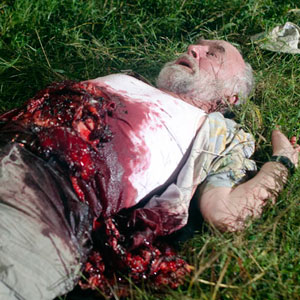
Andrew, an excellent student of mine, asked me this, ‘Are zombies able to tear into someone’s guts with their bare hands? We all know they like to use their teeth but can say Granny Z (that is a zombie with no teeth) uses its hands to tear us into swallow-able pieces? We have already seen zombies have no self-preservation instinct so assuming no atrophy or other degradation of the muscle mass should we not be conscious of the fact that zombies will bring a greater strength to bear as they will not care about injuring themselves? Something any human is capable of (imagine pre-zombie granny Z lifting a car off her grandchild) under particular circumstances’.

I hope the answer is no, but I have my doubts.
Let’s start with the first part, can a human being tear apart another human being bare handed? Well yes, yes they can. As recently as October 2011 a man in Italy tore out his own eyeballs during a Church sermon, and in 2006 a man in the USA lifted a 3,000 pound car to free an injured cyclist. With practice most of us could tear a phone book in half, even if I myself have never managed it.

Success! I can't wait to call my friends, what are there numbers? Oh.
But a person suffering from our proposed Zombieism Prion Disease would be very unsteady on their feet, and have poor control over their limbs. Also, because Zombieism would be a new form of prion disease, it may incorporate the symptoms and characteristics of other current prion diseases. For example Chronic Wasting Disease (CWD), causes amongst other things, extreme weight loss. Although it affects animals at present CWD could develop into part of the new Zombieism Prion Disease. So there is a good chance Zombieism would reduce a person’s strength considerably.

With regard to self-preservation amongst zombies, we certainly see that symptom in the movies, with zombies happily walking through rotor blades on the off chance of getting a snack. In our studies we have concluded that real life zombies would feel pain. The condition congenital insensitivity to pain (CIP), which prevents sufferers feeling the signal of pain, is something one is born with. It cannot be caught like a cold. This condition is the closest comparable one we’ve found to that fictional zombie symptom. CIP is very rare, with only around 100 cases in the USA, so we can bet a real zombie is very unlikely to have that symptom.

No stinkin' helicopter rotor is getting between me and my brunch.
However we know that Zombieism causes a lot of damage to the brain. One area of the brain, the amygdala, is responsible for our instincts. Shaped like an almond, and buried deep with the temporal lobes, it produces much of not only our instincts, but our base emotions as well. If Zombieism caused damage to this area, it may produce a zombie that was overcome with instinct, so much so it may show disregard for pain, even if it was feeling it.

Finally let’s go back to those events, like Andrew’s ‘Granny lifting a car idea’, where people show moments of almost super human strength. In a dangerous situation the human body goes through some interesting changes.

I'll either lift that car, or shoot it off. 
In the brain, the hypothalamus activates, sending a chemical signal adrenal glands. These glands produce adrenalin, which is to the human body, what spinach is to Popeye. When fuelled by adrenalin our muscles are able to contract more. This suddenly gives us the ability to perform actions, like lifting a car, actions we normally couldn’t have managed. Some believe that most of time we only use a small proportion of our strength. When under threat we simply gain the ability to expand on what we already have. But these fits of strength are short lived. Within a few minutes of happening the body begins to return to a more normal state.

It’s a lot like those friends of Captain America, the Six American Warriors, who were given a less refined version of the super solider serum. It gave them Cap’s powers but only for a short time. Inevitably these newly found super powers would give out during a pivotal moment in the plot. On the bright side they do always return during final battles.

The Six American Warriors, well, em, I can name one...
To conclude; zombies do have the potential to tear a human apart. Like humans, when faced with a dangerous situation they may also receive an adrenalin rush, giving them a short burst of enhanced strength. However the Zombieism disease would be badly affecting their ability to move both legs & arms, and may be causing wasting of the body. So they may lack comparable strength to a healthy human.

Ultimately zombies are like fingerprints, each one is different. And just like fingerprints they inevitably end up all over your glass door. No zombie would have the exact same presentation of the disease as another, so some may be more akin to human, and others more akin to demons.

I just washed these you inconsiderate fiends! 
Thank you Andrew for a great question, and if any of you out there want to know anything about the real science behind zombies, do get in touch on info@zombiescience.co.uk.

Best wishes,

Doctor Austin
Doctor Austin ZITS BSz MSz DPep, is a Theoretical Zombiologist and Head of the Zombie Institute for Theoretical Studies at the University of Glasgow, Scotland UK.  
For even more Zombie Science pick up the official Zombie Science book on Amazon now