Showing posts with label world war z. Show all posts

Wednesday, 11 September 2013

Zombie Vs Predator

Ahoy-hoy Zombie Fans, good to have you here for today’s ZomBlog.

Once again I’ll be endeavouring to shine some scientific sense over your Zombiology questions.


The first question we have today is from Lee who asks,
“How do zombies sense their prey? Their eyes are often portrayed as cloudy, so can they see? Can they just 'see' movement? Do they develop other senses, to pick up heat for example? As their infected brains can barely function enough to move their atrophied limbs, how difficult it must be to use barely functioning senses.”
A real Zombie would of course be more like a human being than their fictional counterparts. They’d have the same senses as we do. In movies they are often shown as being super sensitive to smell, noise, and so on. This of course makes for a more dramatic and scary scene, but isn’t based in reality.


The same is true for the eyes. It is creepier to have a Zombie with cloudy, grey, and generally dead eyes. In the book World War Z, one of the characters explains that Zombies don’t blink and their eyes become cloudy as scratches form. 

First we kill the Zombies. Then we kill the spirit of the book.
For us un-undead blinking is an important function. It provides moisture to the eye, allowing us to see nice and clearly. If a human with the Zombie disease didn’t blink, their eyes would dry out, and they would eventually become completely blind.


Real Zombies would be primarily guided by sight and as I mentioned in this previous blog, humans are naturally good at seeing living things compared to inanimate objects.


Unfortunately gaining thermal vision, like the Predator, is out of the realms of possibility for the moment. If we could see the infrared spectrum it would completely overwhelm our eyes.     
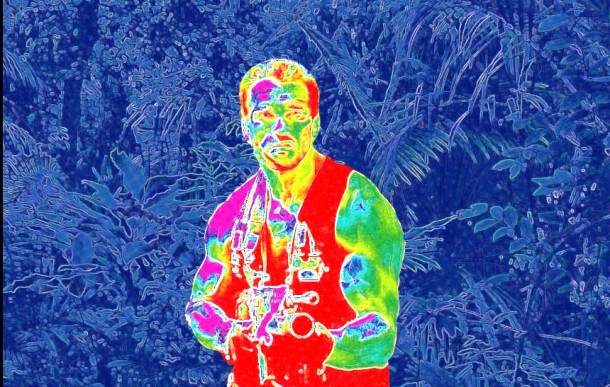
Is that the former Governor of California?
So the answer to Lee’s question is that Zombies sense their prey the same way humans do, by seeing, hearing, or smelling them. Lee is right to point out that the damage to their brains is already causing them problems in moving, and in interacting with the world around them. So they’d be utterly terrible at hunting humans - luckily for us!


Next our inquisitive student Nico got back in touch with another question, “What should you do before a zombie crisis ? Buy guns?”


Here at the Zombie Institute we believe that all life is sacred, even Zombie life, and we would never condone or encourage the use of involuntary euthanasia to deal with a Zombieism outbreak. That’s a practice Hitler used, and as a rule, anything Hitler does, we avoid. Tiny mustaches, VW cars, Hugo Boss, etc.


In the event of a Zombie outbreak taking off, there are many excellent government and international agencies who would swoop in to help deal with it. If you look at recent disease outbreaks, Mad Cow Disease, Bird Flu, Swine Flu, and so on, you can see how well they have been dealt with without becoming extreme pandemics akin to the plagues of old.


However, if we take Nico’s question as wondering what to do if, for reasons unknown, the Zombieism disease spreads like we see in fiction there are some things you can do to prepare. As Sun Tzu said, know your enemy. 
All great minds know the work of Sun Tzu. And Paris Hilton, who thinks 'that's hot'

By learning all you can about how diseases work, how to control them, and how to treat them you’ll know how best to proceed. For example, if the disease is viral, swallowing a movie star quantity of antibiotics won’t help a bit. If the disease is spread by a bite, and moves through the body very quickly upon infection, there is little point in chopping off your limbs as a preventative measure. Knowledge is power, and by studying this blog, as well as the information on our Institute website you can begin to get educated. You can also attend our live lectures or tutorials. Find one near you on the Tour Dates section of the website .


There are many excellent guides on the internet to preparing for apocalyptic scenarios, so get researching if you’re concerned. Don’t forget the simple stuff, Zombieland taught us the importance of cardio and I personally love this running app, Zombies Run!
I always find sports bras, amazing how these apps know you so well
It has a splendid story intertwined with terrifying Zombie chases. Although, my neighbours have been avoiding me since I began running around shouting about invisible Zombies. And since I got the app too.


So to answer Nico’s question, there are many ways we can prepare for a Zombie disease crisis scenario. But don’t be too scared, here at the Institute we’re looking out for you. As I told the freshman students this week at STD Awareness Day, prevention is better than cure.    


My thanks to Lee and Nico for asking today’s questions. If you have a question you’d like me to answer here in the ZomBlog. Why not leave it as a comment below? Or visit our Book of Faces and ask your question there.


Whatever Zombie knowledge you desire, I’ll do my utmost to oblige.


Take care out there students,


Doctor Austin


Doctor Austin ZITS BSz MSz DPep, is a Theoretical Zombiologist and Head of the Zombie Institute for Theoretical Studies at the University of Glasgow, Scotland UK.


The brand new lecture Zombie Science: Brain of the Dead is premiering at the London Horror Festival on the 28th & 29th of October 2013, find out more here, (http://www.londonhorrorfestival.com/whats-on/zombie-science-brain-of-the-dead/) and book your tickets by calling 020 7482 4857

Wednesday, 21 August 2013

Zombieism: Eat, Sex, Poop

Hello there Zombiology Student, it’s great to have you with us at the ZomBlog.

Today we have a terrific trio of Zombie Science questions from some of our students.

First off we have Ida who asks, “Do zombies have a functional digestive system, and do they defecate?”

I love human, but it goes straight through me.
Let’s begin with the first part. In fiction Zombies have a continual craving for human flesh, yet they are said to not require nourishment. Regular visitors will know that here at the Institute we have a different idea of what a real Zombie would be like. First off, we don’t believe Zombies would be ‘undead’ but rather human beings suffering from a disease. Humans have to ingest certain materials which the digestive system processes and turns into energy in order for us to survive . Zombies move around, so they must be using some form of energy. In order to get this energy their bodies must be processing what they eat, therefore they will need to have a functional digestive system.

But do they defecate? Defecation is the last part of the digestion process whereby solid, semi-solid, or liquid waste is eliminated from the digestive tract via the anus. As we have established, Zombies are using their digestive systems and to use an old adage ‘what comes in must go out’. However, the damage a Zombie disease would do to a human brain could cause changes in behaviour. So don’t expect a Zombie to excuse themselves to the bathroom. They’d likely go wherever and whenever they needed to, we should count ourselves lucky that TV and Film has yet to develop smell-o-vision.

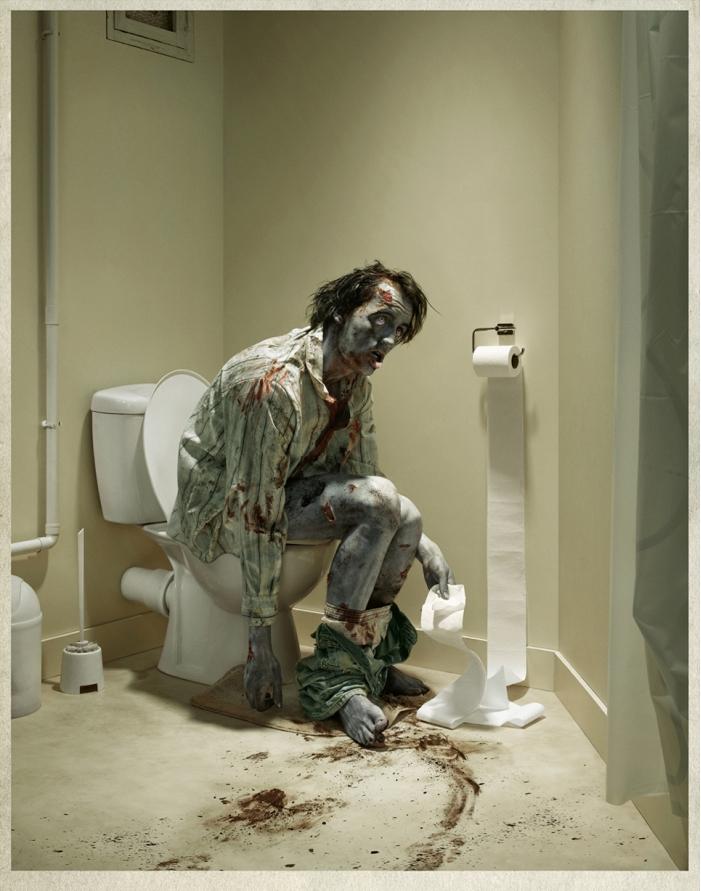
Except this Zombie, he has standards.
Next up is Paul who wanted to know, “Can they mate or bear children?”

The answer depends on how we approach the question. A Zombie disease that is spread by biting, akin to Rabies, is contained within saliva and transferred by a bite. The disease increases aggression raising the Zombie’s chances of biting someone, spreading the disease, and therefore creating infected Zombie offspring. So from that perspective, yes they can in a way create more Zombies.

However I believe Paul’s question really relates to whether a human with Zombieism could have intercourse and produce a child the ‘old fashioned way’.

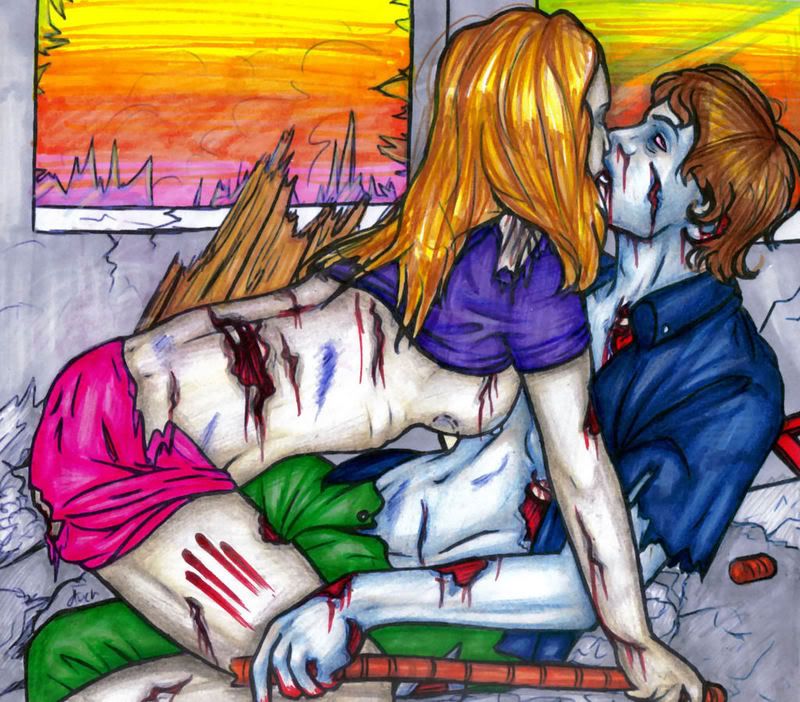
This was the only appropriate 'Zombie Sex' image I could find. I saw things students, things I'll never be able to un-see. 


Surprisingly we have not conducted much research into Zombie Sex. Although in a previous ZomBlog we did answer the question, “If a Zombie bites a pregnant woman, would the baby become infected?” (http://zomblogofficial.blogspot.co.uk/2011/07/babies-first-bite.html)

We believe that a Zombie disease would be affecting the human brain in a variety of ways, affecting memories and altering their personalities. This could mean that a Zombie may not be interested in sex, nor able to recall how to do it. Yet there is nothing to say that the biological facilities required to create a baby would be non-functional. If two Zombies did make love, it would be an instinctive behaviour, much like when two animals go at it in the wild. Of course the Zombie’s wouldn’t have hospitals, midwives, and so on. So if a Zombie did become pregnant, once she came to term the baby would simply drop out and without the proper care it is unlikely to survive for long.

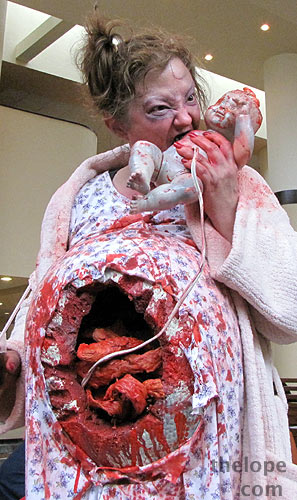
A Zombie giving birth is essentially a packed lunch.
Lastly Colin asked, “Why don’t zombies feed on each other in a frenzy?”

This is a question that many have asked when watching Zombie films. A possibility may be that a Zombie is capable of sensing the Zombieism disease by smell, and therefore avoids it in favour of non-infected food. There are countless stories of animals such as dogs and cats being able to detect disease in humans. But, these animals have far superior smelling abilities than humans so it seems unlikely that a Zombie would have such a skill.

Did you hear that World War Z?


Another idea is that the disease may be altering their behaviour in such a way to discourage them from infecting those who already have the disease. There are many parasites who alter their hosts behaviour. When the malaria parasite plasmodium infects a mosquito it initially makes them more cautious and less likely to bite. This provides time for the disease to reproduce in their guts. Afterwards it makes them bite more frequently, and for longer, increasing odds the parasite will spread. Yet once a human becomes infected they give off signals that attract more mosquitoes.

At present we could hypothesize that a Zombie disease is in some way discouraging infected hosts from biting those who are infected. A reason for this would be because its aim is to spread the disease, and to do that it makes more sense to bite someone who is uninfected. But we would need to learn a lot more about Zombieism to provide a definitive answer. This is what makes studying Zombieism so exciting - the unanswered questions!   

My thanks to Ida, Paul, and Colin for their brilliant questions - I hope you are satisfied with the answers.

If you have a question about the undead please get in touch with me in the comments section below, and don’t forget to visit our Book of Faces (www.facebook.com/zombiescience). I’m ready, waiting, and willing to answer your questions right here on the ZomBlog.

Remember in the fight against Zombies the greatest weapon is knowledge, and crossbows, but mainly knowledge.

Doctor Austin

Doctor Austin ZITS BSz MSz DPep, is a Theoretical Zombiologist and Head of the Zombie Institute for Theoretical Studies at the University of Glasgow, Scotland UK.


Wednesday, 14 August 2013

Team Zombie

Good day Zombiology Student and thanks for stopping by the ZomBlog.

Today I’m answering a question that came in via the Book of Faces from Jim;

“Hey Doc. I was wondering if Zombies would have organisation skills? I'm not talking about becoming wedding planners or the like but think more along the lines of "The leader" from I Am Legend. Would Zombies be able to lead other zombies with instructions and would those zombies be able to follow them?”
The leader from 'I Am Legend' - more appealing that most political leaders
To begin answering this fascinating question, let’s learn a little something about instinct.

Whilst being a complicated term, instinct essentially refers to the in-built responses seen in animal species. These responses are predictable in a variety of situations for example, many animals will attack anything that threatens their offspring, a cornered animal will either fight, run, or play dead, and most animals demonstrate built in food finding behaviours.

But when it comes to humans, instinct becomes more complicated especially because our brains are capable of overriding instinct, or over expressing it.

Take survival for example. There are many who would argue that the survival instinct is inbuilt into humans. Yet that doesn’t seem to be the case for newborns, young children, and even teenagers - who continually put their survival at risk. You need only look at the newborn who tries to swallow coins or the teenager who drives recklessly to see that in action.

Survival of the Drunkest 

Human instincts are strongly linked to an area of the brain known as the amygdala. This almond shaped structure is one of the oldest parts of the brain from an evolutionary perspective. The amygdala plays a key part in what has been called the "general-purpose defense response control network" and gives rise to whether we will attack or retreat when faced with a specific situation, better known as the “fight or flight” response.

Our research into Zombieism has indicated that the condition could be caused by damage to the human brain including the amygdala. So it is likely that a Zombie would be inclined to act instinctually, certainly more than a uninfected human.

However, this same damage would mean that an individual Zombie lacks the ability to act as a leader and Zombies themselves would be unresponsive to following instruction.

Organizing Zombies would be akin to herding cats. Or directing an episode of Geordie Shore
But this doesn’t mean that Zombies could not appear to have organisational skills, or even act in a collective manner.

A study published in the Proceedings of the National Academy of Sciences found that humans seemingly have a hard-wired ability to notice living things. The study's subjects watched images of various outdoor scenes, two at a time. The second image was slightly different from the first. The differences covered a variety of things, from living animals and humans to inanimate objects such as cars. The results showed that humans can identify changes much faster and more accurately if they're living things. Nearly 90 percent of the living changes were spotted compared with 66 percent for inanimate objects. In other words, we're naturally wired to look out for living things. So it is feasible that a Zombie would be better able to spot and therefore target living things like humans. This could explain why they would be drawn to attacking humans and in a sense would appear to be specifically targeting them.   

We can also consider the area of sociology known as collective behaviour. Collective behaviour is when people engage in interactions in response to unstructured, ambiguous or unstable situations. All of which cover Zombies rather well.

Zombieism is highly likely to affect the aforementioned amygdala, leading to heightened aggression. Therefore a horde of Zombies would be defined in this area of sociology as a mob, because they are an emotionally aroused crowd intent on violence or destructive action.  

Rather aptly the coming together of such a mob is described under “Contagion Theory”, whereby people get swept up in the behaviors of others and act like herds of cattle. Yet a large number of Zombies coming together may only appear to be an example of “herd mentality” rather than actually being one. Take the situation shown in the recent Zombie film “World War Z”. Brad Pitt visits Jerusalem where large walls are keeping the undead out. The loud singing of the assembled crowd attracts the Zombies, who pile against the walls, eventually climbing over one and another until they get in.

Zombie piley-on in action
Observing this, one might think that it is a clever tactic on the Zombies’ part. Using teamwork to reach their prey. In actual fact every Zombie is acting on their individual desire to reach the sound. The action of forming of Zombie Tower, akin to an army of ants, is not a purposeful choice but merely a by-product of the mass of Zombies trying to reach the sound.

Now Zombie Ants, that'd be scary. Or a good Pixar film.
So the answer to Jim’s question, would Zombies have organisation skills, is ultimately no, but they might appear to when observed. The second part of his question “Would Zombies be able to lead other zombies with instructions and would those zombies be able to follow them?” is also presently a no. Their brains would have been too badly damaged to leave leadership skills intact and if by chance one could act as a leader the others would not be able to understand or follow their instructions.

Many thanks to Jim for an excellent question, and if you have a question about the undead please get in touch with me in the comments section below, and don’t forget to visit our Book of Faces (www.facebook.com/zombiescience). I’m ready, waiting, and willing to answer your questions right here on the ZomBlog.

Keep your eyes to the sky, and your ears to the ground, because you never know when Zombies are around.

Doctor Austin

Doctor Austin ZITS BSz MSz DPep, is a Theoretical Zombiologist and Head of the Zombie Institute for Theoretical Studies at the University of Glasgow, Scotland UK.


Wednesday, 31 July 2013

Zombies - Fast Vs. Slow

Good day Zombiology Students and thanks for stopping by the ZomBlog.

The release of the Zombie epic ‘World War Z’ has reignited the debate on whether the undead would move with the shambling strength of a Glaswegian on a Friday night, or strafe the apocalyptic landscape like a decomposing Usain Bolt.

It's still preferable to a budget airline
In today’s ZomBlog I’m not going to explore the issue from the ‘what makes a good film’ perspective, but rather examine what science can contribute to the debate.

Let’s begin by exploring how a disease, like Zombieism, could create the staggering, slow moving monster we encounter in so many undead incarnations.

There are two main areas of the human brain that control movement and coordination. These are the cerebellum and basal ganglia.

The cerebellum essentially tunes and refines our movements. Imagine you are learning to balance on a board placed on a ball. You'll likely tip forward or backward, and have to lean to adjust your body to correct your balance. As you perform and repeat this action your cerebellum is learning, and with enough practice you will be able to get your balance quickly.

This elephant's cerebellum has mad skillz
If this area is affected by a disorder you will have a wider stance as you attempt to balance. When you try to walk you could easily fall and when trying to perform an action, such as touching your nose with your finger, you will often miss.
The basal ganglia are responsible for selecting a particular movement, or a series of movements. When you decide to give someone a 'high five' the basal ganglia prevent you from wiggling your leg at the same time you raise your hand.
If the basal ganglia are damaged you may become slow to begin making movement. For example if I throw a ball to you, it will have bounced off your face before you even begin raising your hand and once the movement has started you will be slow in carrying it out.

You know when you've be basal ganglia-ed
Therefore we can conclude that if the Zombieism disease is damaging or impairing the aforementioned areas of the the brain it will produce in humans an unsteady and slow Zombie-like walk.  

How then could a disease evoke the opposite effect, giving us unrelenting, fast moving Zombies?

When we face a dangerous situation, inside our brain, the hypothalamus activates, sending a chemical signal to the adrenal glands which are next to your kidneys. These glands produce adrenalin, which is to the human body what spinach is to Popeye. Fuelled by adrenalin our blood flows more easily to our muscles, bringing more oxygen with it, ultimately letting them work at heightened levels. This gives us the ability to perform actions, like running fast, slightly better than we normally would. Rather than gaining a new ability, it simply expands on what we already have. But these fits of speed are short lived as within a few minutes the body begins to return to a more normal state.

But what if we continued in this state, would that give us the unrelenting abilities of the fast Zombie? Not for long, as we’d enter a state of exhaustion, damaging our immune systems and increasing our chance of having a heart attack. Simply put, the body would run out of steam.

So in reality would a disease that causes Zombieism be more likely to give us a fast or slow Zombie? The answer, for now, has to be - slow.

My personal thoughts on the debate summed up by a meme
Disease itself means, ‘a disordered or incorrectly functioning organ, part, structure, or system of the body’. A disease makes us worse than we are normally, it doesn’t improve us. I for one am particularly bad at running so it is unlikely that contracting a massively debilitating disease like Zombieism would suddenly give me Olympic level speed. Although if Usain Bolt contracted Zombieism I would be a little bit worried.

First I break a world record - then I eat your face
Of course, we’re dealing with Zombies from the perspective of science. In the fictional worlds of Zombie films, TV shows, games and books it may well be something ‘supernatural’  that gives them these amazing abilities. Couple that with the wonderful ways diseases are changing in our world and perhaps one day science will give us those terrifying fast moving ghouls.

If you have a question about the undead please get in touch with me in the comments section below, and don’t forget to visit our Book of Faces (www.facebook.com/zombiescience). I’m ready, waiting, and willing to answer your questions right here on the ZomBlog.

Take care out there,

Doctor Austin

Doctor Austin ZITS BSz MSz DPep, is a Theoretical Zombiologist and Head of the Zombie Institute for Theoretical Studies at the University of Glasgow, Scotland UK.