Showing posts with label zombiology. Show all posts

Monday, 18 August 2014

Doctor Austin to retire

  
Doctor Austin
Head of the Zombie Institute for Theoretical Studies
1996 - 2014

To all my students,

The time has come for me to retire as Head of the Zombie Institute for Theoretical Studies. I want to thank each and every one of you for giving me the honour of teaching you about a subject I care so very passionately about. I have been so fortunate to have such a brilliant career, it has been wonderful. I know that all of you will carry on the study of Zombies and Zombieism, and take it to places I could only dream of. There are further details of my retirement in the official press release below.

I know the Institute is in safe hands, and will continue to deliver you all an excellent dose of Zombie Science.

Stay safe out there,

Doctor Austin

PRESS RELEASE

Issued: 18/08/2014

For Immediate Release

WORLD-RENOWNED THEORETICAL ZOMBIOLOGIST DOCTOR AUSTIN RETIRES

World-renowned Theoretical Zombiologist Doctor Austin is to retire from his post as Head of the Zombie Institute for Theoretical Studies, at the University of Glasgow, on Monday the 25th of August 2014. Appointed in 1996, Doctor Austin has been responsible for the development of the Prion Zombieism Theorem as well as the Institute’s public engagement programme. The latter took the form of the spoof lectures and tutorials, Zombie Science 1Z, Worst Case Scenario and Brain of the Dead. Supported by the charity Wellcome Trust, these events have been seen by over 40,000 people since their inception in 2010. Two of these shows are currently taking place at the Edinburgh Fringe Festival. 
 
Doctor Austin has worked extensively on the subject of Zombiology, spending time researching Kuru in Papua New Guinea during the 1960s and studying variant Creutzfeldt-Jakob disease in the 1990s. As Head of the Institute he has taken awareness of Zombieism to an all time high. Of his decision to retire, Doctor Austin has said, ‘I have enjoyed every moment of my time at the Zombie Institute and have been humbled to work alongside a lot of truly wonderful people. I am particularly proud of the public engagement programme through which I met so many interesting and varied individuals. I’ve always believed that science isn’t for a select few, it’s for everyone, and that’s what drove me during my years touring the world.’

The University of Glasgow have yet to announce a successor for the Institute, which first opened on campus in 1803. Doctor Austin has stated that he will remain on as Zombiologist Royal to Her Majesty the Queen, until such time as an appropriate replacement is selected.

Doctor Austin will present his final public lectures at the Edinburgh Fringe, every night until the 25th of August. The sixty minute shows’, Zombie Science: Brain of the Dead and Worst Case Scenario adopt Doctor Austin's unique combination of comedy and science. Worst Case Scenario sees the audience make decisions on dealing with a Zombie outbreak. The choices they make alter the outcome - meaning no two shows are ever the same. Brain of the Dead allows the audience to experience life as a Zombie.

Asked about this, and his future plans, the Doctor said, ‘the Fringe is a brilliant way to end my career, it’s a fascinating place, full of terrifically talented people. I have spent my whole life exploring strange environments, and this is no exception. But after a long time on the move I look forward to spending my retirement with my family and allowing the next generation to push the study of Zombiology to exciting new levels.’

Notes to Editors

About Doctor Austin;

Doctor Austin is a Theoretical Zombiologist at the University of Glasgow and has been Head of the Zombie Institute for Theoretical Studies since 1996. His theories on Zombieism have been published worldwide in publications as diverse as The Times, The Guardian (Las Vegas), The Daily Mail, Playboy (Russia), The Zombie Times and The Metro. Doctor Austin has appeared on the BBC, Sirius XM (USA), RTE Television (Ireland) and is the author of Zombie Science 1Z, a guidebook to the science of the undead, first published in 2010.  

Lecture Details;

Zombie Science: Brain of the Dead – Edinburgh Fringe 2014
18th - 25th August at 7.10pm (1hr)
Tickets: £6.50 - £10.50
C Venues, Adam House, Chambers Street, EH1 1HR
Fringe Venue 34
C Venue Box Office: 0845 260 123 / www.cthefestival.com
Fringe Box Office: 0131 226 0026 / www.edfringe.com

Zombie Science: Worst Case Scenario – Edinburgh Fringe 2014
18th - 25th August at 10pm (1hr)
Tickets: £6.50 - £10.50
C Venues, Adam House, Chambers Street, EH1 1HR
Fringe Venue 34
C Venue Box Office: 0845 260 123 / www.cthefestival.com
Fringe Box Office: 0131 226 0026 / www.edfringe.com

Web Links;

@ZombieScience1Z
  
##Ends##

Doctor Austin with Her Majesty the Queen


Tuesday, 1 July 2014

Book Review: Each New Morn

Good day Zombiology students,

Thank you for stopping by the ZomBlog. Today I’ll be taking a break from science to review Each New Morn a post-apocalyptic thriller from L. G. Thomson. My usual caveat applies, I am a scientist, not a critic, therefore I can only share my personal thoughts of the book. I must also declare a conflict of interest, as I make a special appearance in the story! In fact the book holds a special place in my heart as the author found inspiration from some of our science in the creation of her Zombies - a most humbling honour.


Each New Morn follows survivors of a deadly prion disease named Falling Down Flu. I can hear scientists grinding their teeth, as influenza refers to a virus not a prion, but settle down, this is explained in the book. This isn’t your traditional Zombie story, in fact the word Zombie is rarely used and the disease has many unique factors that set it apart from the standard Romero model. The outbreak begins with patients falling into a sleeping state for a short period. Some wake up fine, some never wake again and others, well, they come back different.

The story begins with Chrissie, a woman alone in her home, where other members of her family haven’t woken up. Anarchy has overwhelmed the streets and she makes the decision to take a car and seek safer pastures. As is often the case, Chrissie discovers that the most dangerous element of the apocalypse is not the infected but other humans.


In the second part we are introduced to Shaw, a man who was trapped on a visit to his home village and like Chrissie, his family doesn’t awaken with him. He does have a lovely dog, Toby, for company. It is here that we have our first encounter with a ‘Zombie’. This doesn’t happen until more than 80 pages in, very unusual for a Zombie tale, however I found the story so gripping, that I hadn’t even noticed. After dispatching the first of many undead monsters, Shaw begins to assemble survivors and they struggle to survive against the conditions of the remote Highland area.

I’m cautious not to reveal too many of the exciting twists and turns in the book, spoilers I believe they are called. But I must discuss the Zombies because I really loved (and was terrified) by them. Those who awaken changed behave in some of ways we expect of a Zombie. They are aggressive, relentless and difficult to kill. In a break from the norm they do not moan – they scream. Nicknamed Screamers they roam the night wailing horribly. This is a nice nod to the banshee, a fixture of Scottish Gaelic mythology. These creatures are also vulnerable to injury in a more human way, meaning it’s not just a headshot that’ll take them down. I liked that because from a scientific perspective the lack of explanation as to how the body functions without blood flowing, or consumed food & drink being transferred to energy, is a bit confusing.

Overall the story is action packed – it covers a long journey and a long period of time. It explores areas many other Zombie stories overlook, such as the rise of feral animals, an explosion in the insect population and the realistic decay of the things we humans leave behind. The approach is different from other Zombies stories, making it a fresh and surprising read – and as an avid fan of all things Zombie this doesn’t happen to me often. It is set in Scotland, and being my home country, I liked that a lot. There’s something exciting about being able to visualize these events happening in your immediate world. My only slight confusion was why American terms were used, such as ‘gas’ and ‘store’, as the characters were not American. Perhaps this helps with international sales.

If you’d like a gripping, fresh take on the Zombie genre, packed with tension and surprises that are equally pleasant and horrible then Each New Morn is for you.       


L. G. Thomson’s Each New Morn is available on Amazon and more information can be found on the official website.

I’m going to the Edinburgh Fringe 2014 with two offerings from Zombie Science, details below;

Zombie Science: Brain of the Dead – Edinburgh Fringe 2014
30th July - 25th August (not 12th) at 7.10pm (1hr)
Tickets: £6.50 - £10.50
C Venues, Adam House, Chambers Street, EH1 1HR
Fringe Venue 34
C Venue Box Office: 0845 260 123 / www.cthefestival.com
Fringe Box Office: 0131 226 0026 / www.edfringe.com

Zombie Science: Worst Case Scenario – Edinburgh Fringe 2014
30th July - 25th August (not 12th) at 10pm (1hr)
Tickets: £6.50 - £10.50
C Venues, Adam House, Chambers Street, EH1 1HR
Fringe Venue 34
C Venue Box Office: 0845 260 123 / www.cthefestival.com
Fringe Box Office: 0131 226 0026 / www.edfringe.com

Stay safe out there,

Doctor Austin   

Doctor Austin ZITS BSz MSz DPep, is a Theoretical Zombiologist and Head of the Zombie Institute for Theoretical Studies at the University of Glasgow, Scotland UK.

Monday, 30 September 2013

Angry Zombies

Fit like there students, help yourself to a cup of tea and let’s get into today’s ZomBlog.

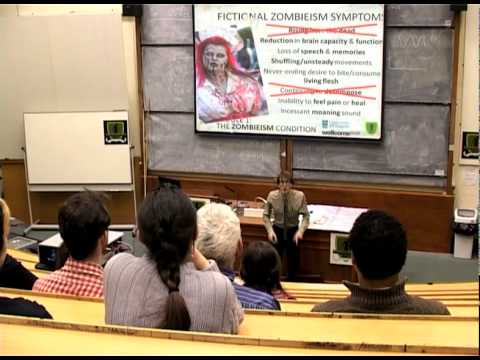
I’m preparing our new public lecture, Zombie Science: Brain of the Dead, for it’s debut at the London Horror Festival. In this lecture I’ll be delving into the Zombie brain. Today I thought I’d share some insights into a part of the brain called the amygdala, and what its role is in Zombieism.
The amygdala lies deep within the brain and is about the size of an almond. It plays a key role in the display and control of aggression.

During a study involving monkeys, their amygdalae were stimulated electrically. This led to an increase in aggression. The fact that monkeys react angrily to having their brains electrocuted isn't exactly a revelation, but us scientists have to pass the time somehow.
The size of the amygdala is known to correlate with how aggressive a species is. If a male is castrated, the amygdala can shrink by up to 30 percent. This may offer one method of calming down male Zombies, but, as opposed to the head, usually offers a smaller target.
I'm personally uncomfortable just looking at this tool, never mind attempting to use it on a Zombie
A reason that Zombieism may want to manipulate this area, and cause increased aggression, is to help it spread.
Recent research suggests that parasites often take up residence in the amygdala. The parasite, toxoplasma causes the disease, Toxoplasmosis. Its preferred host is a cat however if it infects a mouse or rat, it changes their behaviour to make them attracted to cat odours. This will increase their chance of being eaten by a cat thus placing the parasite in the host it desires.
Unless of course the mouse has a basic understanding of explosives
In a similar way Zombieism could twist the amygdalae to do its bidding by altering Zombie behaviour, making Zombies more likely to bite, and therefore improving the odds the disease will be transferred.

Zombies biting is a bit of a ‘three for the price of one’ bonus. It’s how they breed, feed, and make us humans take heed.

Find out more about the undead brain by joining me on the 28th & 29th of October 2013 for the brand new lecture Zombie Science: Brain of the Dead at the London Horror Festival, find out more here, and book your tickets by calling 020 7482 4857. The lecture is part of a 3 year project supported by a Society Award from the Wellcome Trust.

Don’t forget, if you have a question you’d like me to answer here in the ZomBlog why not leave it as a comment below? Or visit our Book of Faces and ask your question there.

When it comes to the science of Zombies we’ve got it covered, or at the very least, we can make it sound like we do.

Keep up the good work my students,

Doctor Austin

Doctor Austin ZITS BSz MSz DPep, is a Theoretical Zombiologist and Head of the Zombie Institute for Theoretical Studies at the University of Glasgow, Scotland UK.

Wednesday, 11 September 2013

Zombie Vs Predator

Ahoy-hoy Zombie Fans, good to have you here for today’s ZomBlog.

Once again I’ll be endeavouring to shine some scientific sense over your Zombiology questions.


The first question we have today is from Lee who asks,
“How do zombies sense their prey? Their eyes are often portrayed as cloudy, so can they see? Can they just 'see' movement? Do they develop other senses, to pick up heat for example? As their infected brains can barely function enough to move their atrophied limbs, how difficult it must be to use barely functioning senses.”
A real Zombie would of course be more like a human being than their fictional counterparts. They’d have the same senses as we do. In movies they are often shown as being super sensitive to smell, noise, and so on. This of course makes for a more dramatic and scary scene, but isn’t based in reality.


The same is true for the eyes. It is creepier to have a Zombie with cloudy, grey, and generally dead eyes. In the book World War Z, one of the characters explains that Zombies don’t blink and their eyes become cloudy as scratches form. 

First we kill the Zombies. Then we kill the spirit of the book.
For us un-undead blinking is an important function. It provides moisture to the eye, allowing us to see nice and clearly. If a human with the Zombie disease didn’t blink, their eyes would dry out, and they would eventually become completely blind.


Real Zombies would be primarily guided by sight and as I mentioned in this previous blog, humans are naturally good at seeing living things compared to inanimate objects.


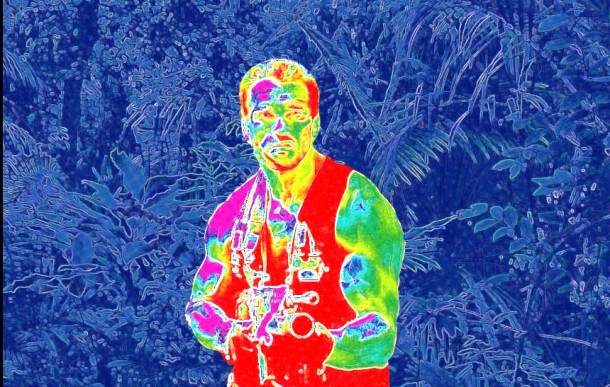
Unfortunately gaining thermal vision, like the Predator, is out of the realms of possibility for the moment. If we could see the infrared spectrum it would completely overwhelm our eyes.     

Is that the former Governor of California?
So the answer to Lee’s question is that Zombies sense their prey the same way humans do, by seeing, hearing, or smelling them. Lee is right to point out that the damage to their brains is already causing them problems in moving, and in interacting with the world around them. So they’d be utterly terrible at hunting humans - luckily for us!


Next our inquisitive student Nico got back in touch with another question, “What should you do before a zombie crisis ? Buy guns?”


Here at the Zombie Institute we believe that all life is sacred, even Zombie life, and we would never condone or encourage the use of involuntary euthanasia to deal with a Zombieism outbreak. That’s a practice Hitler used, and as a rule, anything Hitler does, we avoid. Tiny mustaches, VW cars, Hugo Boss, etc.


In the event of a Zombie outbreak taking off, there are many excellent government and international agencies who would swoop in to help deal with it. If you look at recent disease outbreaks, Mad Cow Disease, Bird Flu, Swine Flu, and so on, you can see how well they have been dealt with without becoming extreme pandemics akin to the plagues of old.


However, if we take Nico’s question as wondering what to do if, for reasons unknown, the Zombieism disease spreads like we see in fiction there are some things you can do to prepare. As Sun Tzu said, know your enemy. 
All great minds know the work of Sun Tzu. And Paris Hilton, who thinks 'that's hot'

By learning all you can about how diseases work, how to control them, and how to treat them you’ll know how best to proceed. For example, if the disease is viral, swallowing a movie star quantity of antibiotics won’t help a bit. If the disease is spread by a bite, and moves through the body very quickly upon infection, there is little point in chopping off your limbs as a preventative measure. Knowledge is power, and by studying this blog, as well as the information on our Institute website you can begin to get educated. You can also attend our live lectures or tutorials. Find one near you on the Tour Dates section of the website .


There are many excellent guides on the internet to preparing for apocalyptic scenarios, so get researching if you’re concerned. Don’t forget the simple stuff, Zombieland taught us the importance of cardio and I personally love this running app, Zombies Run!
I always find sports bras, amazing how these apps know you so well
It has a splendid story intertwined with terrifying Zombie chases. Although, my neighbours have been avoiding me since I began running around shouting about invisible Zombies. And since I got the app too.


So to answer Nico’s question, there are many ways we can prepare for a Zombie disease crisis scenario. But don’t be too scared, here at the Institute we’re looking out for you. As I told the freshman students this week at STD Awareness Day, prevention is better than cure.    


My thanks to Lee and Nico for asking today’s questions. If you have a question you’d like me to answer here in the ZomBlog. Why not leave it as a comment below? Or visit our Book of Faces and ask your question there.


Whatever Zombie knowledge you desire, I’ll do my utmost to oblige.


Take care out there students,


Doctor Austin


Doctor Austin ZITS BSz MSz DPep, is a Theoretical Zombiologist and Head of the Zombie Institute for Theoretical Studies at the University of Glasgow, Scotland UK.


The brand new lecture Zombie Science: Brain of the Dead is premiering at the London Horror Festival on the 28th & 29th of October 2013, find out more here, (http://www.londonhorrorfestival.com/whats-on/zombie-science-brain-of-the-dead/) and book your tickets by calling 020 7482 4857

Wednesday, 4 September 2013

Vegetarian Zombies

Greetings Zombie Seekers, and a warm welcome to another edition of the ZomBlog.

Today I’ll be answering a pair of questions from our fine Zombiology student body.

The first is from Jim who asks, “If someone is a vegetarian in their pre-zombie state would they refrain from meat? And along the same vein could a zombie be able to recognise nuts and berries as food and survive on non-meat products?”


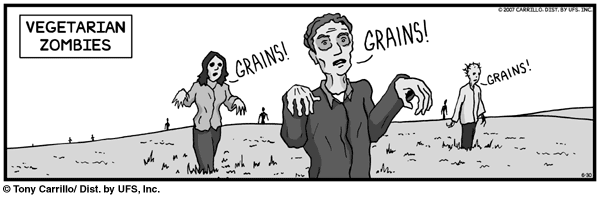
A famous slogan of vegetarianism is “nothing with a face”, and if fiction has taught us anything, it’s that Zombie’s love nothing more than sucking and tucking into a human’s face.

Vegetarianism comes in many forms, some eat eggs, but no other dairy products, and vegans exclude all animal products including clothing such as leather. There are various reasons people abide by these diets, it might be part of their religious practice or for moral reasons but ultimately it is an active choice.

Our current research indicates that a Zombie’s diet stems from the disease affecting an area of the brain known as the hypothalamus. 


The hypothalamus helps regulate appetite by letting us know when we are hungry, or reversely, full. Dysfunction in this region can make us feel like we are never full, causing us to continually eat. This is called hyperphagia. We believe that a Zombie would be hyperphagic and therefore be compelled to eat continuously.

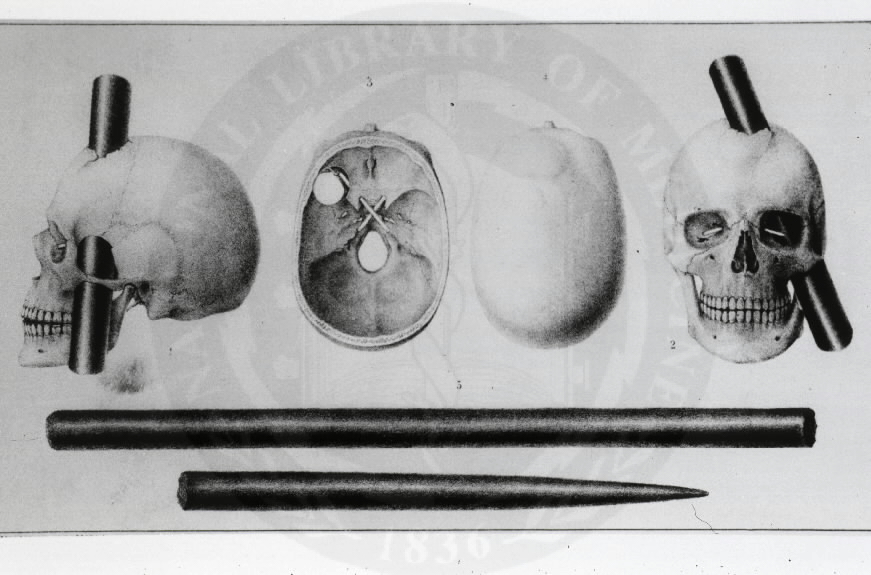
Areas of the brain also play a role in moral sensitivity. In the 19th century a man named Phineas Gage was involved in an accident. An iron bar was blasted through his head, damaging the frontal lobe of his brain and severely changing his personality. Prior to his accident Phineas was a calm mild mannered man, afterward he became an angry womaniser. By studying Gage scientists learned much about the brain, and that the damaged areas were partly responsible for moral sensitivity.

Phineas had great difficulty finding suitable hats after the accident
We must also consider that the Zombie disease is likely to affect a person’s memories, and personality.

If we combine all of these factors it is unlikely that a vegetarian who subsequently becomes a Zombie could remember their previous diet choices, nor care about maintaining them - on top of this the burning compulsion to eat would lead them to devour anything that is available, including meat.

To answer the second part of Jim’s question, could Zombies survive on non-meat products, our current theories indicate that they could and would. A real Zombie, unlike a movie version, does not have a purely cannibalistic diet, and has similar nutritional requirements to a regular human. Read more about our theories in this handy online guide: http://www.zombiescience.co.uk/#!vstc0=zombieism-guide       

In conclusion, a pre-Zombie vegetarian would not carry on this dietary choice once infected, and would be happy to eat anything from meat to veg.
Our second question today comes in from Nico who wants to know, “Do you think its possible for zombies to become useful members of society? For example get jobs etc.”

Of course in some professions no one would notice a difference
The answer to this depends on whether we could develop a treatment for Zombieism that would remove the disease, and whether we could then repair the damage it leaves behind.

If we could do both then Zombies would essentially be human again and able to return to their previous lives.

If we could do neither it would be more difficult, as we’d need to ensure we kept the disease contained and therefore keep infected people away from the uninfected.

If we could remove the disease, but not repair the damage, a Zombie could be left with significant brain injuries leading to difficulties ranging from movement problems to aggression issues. However the human brain is capable of rewiring itself in a process known as neuroplasticity. The aforementioned Phineas Gage overcame many of his initial personality problems over time. So the longer a disease free Zombie lived, the greater the chance it’s brain has of resolving any problems.

Advert for 'In the Flesh'


The television series ‘In the Flesh’ (http://en.wikipedia.org/wiki/In_the_Flesh_(TV_series)) examined this scenario with fantastic creativity, and if you haven’t seen it, I’d recommend you check it out.

So in answer to Nico’s question, I’d optimistically say that yes Zombie’s could become useful members of society. It might take some time for treatments and cures to be developed but we’d never simply give up on helping our fellow humans. Eventually we’d find a way.

A big thank you to Jim and Nico for today’s questions. As always I can answer your questions right here on the ZomBlog. Why not leave yours as a comment below? Or visit our Book of Faces (www.facebook.com/zombiescience) and ask your question there.

No matter how gruesome or tricky, or trickily gruesome, I’ll endeavour to answer them.

Have a Zom-tastic day students,

Doctor Austin

Doctor Austin ZITS BSz MSz DPep, is a Theoretical Zombiologist and Head of the Zombie Institute for Theoretical Studies at the University of Glasgow, Scotland UK.


Wednesday, 28 August 2013

The Zombie Scale

A good day to you fine Zombiology Student, come on in and make yourself comfortable.

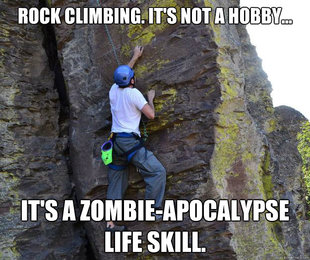
In our ZomBlog today we’re answering a question posed by Chris who wanted to know, “Can zombies rock climb?”

This Zombie is on the fence

Rock climbing is a challenging but extremely fun activity. In the inevitable Zombie Apocalypse it may be reassuring to know you can simply ascend to safety and take up residence in a cave, holding weekend dinner parties with Bigfoot.

But this reassurance may be shattered if the undead can simply shimmy up after you.

Let’s first find out what it physically takes for us humans to climb.

I'm guessing a strong sphincter is one thing
Studies have shown that the average elite male climber is around 5 foot 8 inches, and weighs about 65 kgs. Muscular endurance is important, as you often have to hold your hand in a single position whilst your body moves. What makes climbing rather physiologically unique is that it requires sustained and intermittent contraction of the forearm muscles for upward propulsion. A good climber will generally have a small frame, low body fat, a high level of upper body strength, a reasonable balance of strength between their arms, and a high endurance factor.

Let’s compare that with the physicality of a human suffering from the Zombieism condition.

The areas of the brain known as the cerebellum and basal ganglia are imperative for physical movement, and would likely be affected by Zombieism. Damage to the cerebellum would prevent a Zombie from tuning and refining their movements. This would make conducting the careful and deliberate motions for climbing very difficult.


The basal ganglia helps us select the correct movement in a particular situation. Damage here would prevent the Zombie from actively choosing say, to move it’s hand over moving it’s leg. You can now imagine how this might affect one’s ability to climb.

Furthermore the cerebellum helps us to keep the image our eye’s are seeing still when we turn our head. If it is damaged the image will appear to slip, making it difficult to keep focus on a particular spot such as an important hand hold required for climbing.

So the answer to Chris’ question, “can Zombies rock climb” , is thankfully, no. The disease robs them of the skills required to undertake such a task. When the outbreak begins, rock climbers can simply scale their way up to safety, kick back with Bigfoot and watch the world burn below.


I’m always seeking questions to answer here on the ZomBlog. Why not leave yours as a comment below? Or visit our Book of Faces (www.facebook.com/zombiescience) and ask your question there.

I’m here for all your undead knowledge needs.

Many thanks to Chris for today’s question, and I’ll see you next time, unless you’re out at a rock climbing lesson!

Doctor Austin

Doctor Austin ZITS BSz MSz DPep, is a Theoretical Zombiologist and Head of the Zombie Institute for Theoretical Studies at the University of Glasgow, Scotland UK.