Showing posts with label cannibalism. Show all posts

Wednesday, 4 September 2013

Vegetarian Zombies

Greetings Zombie Seekers, and a warm welcome to another edition of the ZomBlog.

Today I’ll be answering a pair of questions from our fine Zombiology student body.

The first is from Jim who asks, “If someone is a vegetarian in their pre-zombie state would they refrain from meat? And along the same vein could a zombie be able to recognise nuts and berries as food and survive on non-meat products?”
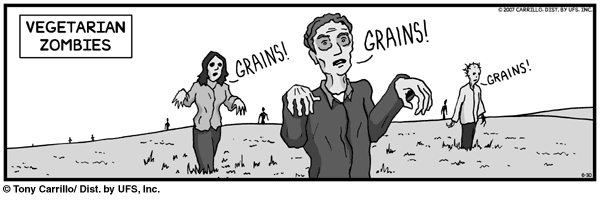

A famous slogan of vegetarianism is “nothing with a face”, and if fiction has taught us anything, it’s that Zombie’s love nothing more than sucking and tucking into a human’s face.

Vegetarianism comes in many forms, some eat eggs, but no other dairy products, and vegans exclude all animal products including clothing such as leather. There are various reasons people abide by these diets, it might be part of their religious practice or for moral reasons but ultimately it is an active choice.

Our current research indicates that a Zombie’s diet stems from the disease affecting an area of the brain known as the hypothalamus. 


The hypothalamus helps regulate appetite by letting us know when we are hungry, or reversely, full. Dysfunction in this region can make us feel like we are never full, causing us to continually eat. This is called hyperphagia. We believe that a Zombie would be hyperphagic and therefore be compelled to eat continuously.

Areas of the brain also play a role in moral sensitivity. In the 19th century a man named Phineas Gage was involved in an accident. An iron bar was blasted through his head, damaging the frontal lobe of his brain and severely changing his personality. Prior to his accident Phineas was a calm mild mannered man, afterward he became an angry womaniser. By studying Gage scientists learned much about the brain, and that the damaged areas were partly responsible for moral sensitivity.
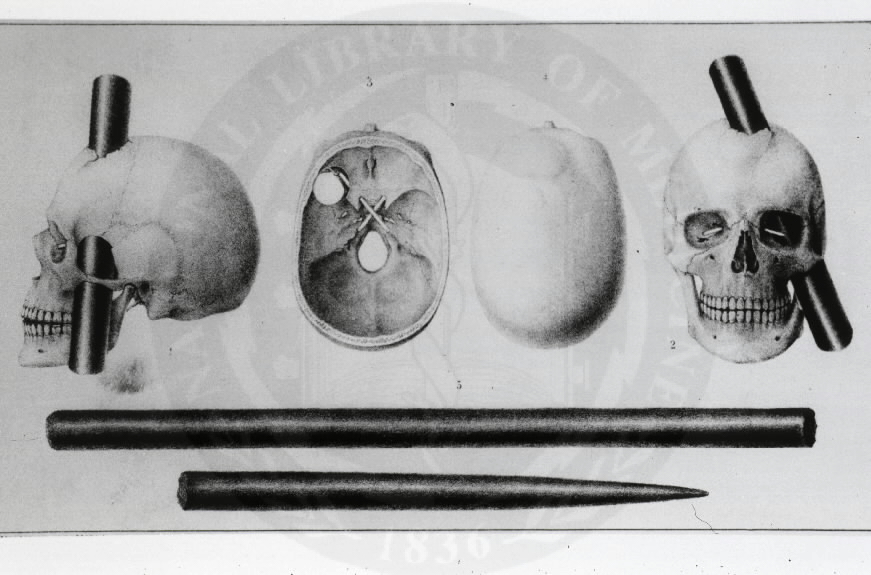
Phineas had great difficulty finding suitable hats after the accident
We must also consider that the Zombie disease is likely to affect a person’s memories, and personality.

If we combine all of these factors it is unlikely that a vegetarian who subsequently becomes a Zombie could remember their previous diet choices, nor care about maintaining them - on top of this the burning compulsion to eat would lead them to devour anything that is available, including meat.

To answer the second part of Jim’s question, could Zombies survive on non-meat products, our current theories indicate that they could and would. A real Zombie, unlike a movie version, does not have a purely cannibalistic diet, and has similar nutritional requirements to a regular human. Read more about our theories in this handy online guide: http://www.zombiescience.co.uk/#!vstc0=zombieism-guide       

In conclusion, a pre-Zombie vegetarian would not carry on this dietary choice once infected, and would be happy to eat anything from meat to veg.
Our second question today comes in from Nico who wants to know, “Do you think its possible for zombies to become useful members of society? For example get jobs etc.”

Of course in some professions no one would notice a difference
The answer to this depends on whether we could develop a treatment for Zombieism that would remove the disease, and whether we could then repair the damage it leaves behind.

If we could do both then Zombies would essentially be human again and able to return to their previous lives.

If we could do neither it would be more difficult, as we’d need to ensure we kept the disease contained and therefore keep infected people away from the uninfected.

If we could remove the disease, but not repair the damage, a Zombie could be left with significant brain injuries leading to difficulties ranging from movement problems to aggression issues. However the human brain is capable of rewiring itself in a process known as neuroplasticity. The aforementioned Phineas Gage overcame many of his initial personality problems over time. So the longer a disease free Zombie lived, the greater the chance it’s brain has of resolving any problems.

Advert for 'In the Flesh'


The television series ‘In the Flesh’ (http://en.wikipedia.org/wiki/In_the_Flesh_(TV_series)) examined this scenario with fantastic creativity, and if you haven’t seen it, I’d recommend you check it out.

So in answer to Nico’s question, I’d optimistically say that yes Zombie’s could become useful members of society. It might take some time for treatments and cures to be developed but we’d never simply give up on helping our fellow humans. Eventually we’d find a way.

A big thank you to Jim and Nico for today’s questions. As always I can answer your questions right here on the ZomBlog. Why not leave yours as a comment below? Or visit our Book of Faces (www.facebook.com/zombiescience) and ask your question there.

No matter how gruesome or tricky, or trickily gruesome, I’ll endeavour to answer them.

Have a Zom-tastic day students,

Doctor Austin

Doctor Austin ZITS BSz MSz DPep, is a Theoretical Zombiologist and Head of the Zombie Institute for Theoretical Studies at the University of Glasgow, Scotland UK.


Wednesday, 13 June 2012

Face Off


Good day Zombie Science Fans,

In the past few weeks the world has been buzzing with stories of potential zombie incidents. Only last week I was on US radio reassuring my American cousin’s that they are safe, and have had many requests to explain what’s going on via the old Book of Faces.

The body of Mr. Rudy (naked) and his victim Mr. Poppo.
It all began with a chap in Miami USA, who spent almost 20 minutes eating a homeless man’s face before being shot dead by police. From there the floodgates opened, not a day passed without someone eating someone’s something, and journalists attributing it all as evidence that the zombie apocalypse is nigh.

Now, no one more than I would welcome the arrival of zombies. Mostly because if they remain theoretical I will have wasted my entire scientific career. But also because it would make it easier for our Institute to acquire research funding.

So are these incidents indicative of Zombieism spreading amongst the population?

No.

And here’s why.

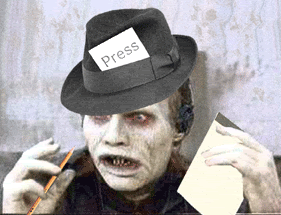
Journalists regularly use the word zombie in their articles to sell more papers, zombie-banks, zombie-youth, zombie-countries, etc. In fact I’ve written about this in a previous blog. It amazes me, given what we know of the industry, that people still believe anything that’s written in a newspaper. But that’s away from the subject.

If we put zombie in the headline twice we'll sell double the amount. Throw in our integrity too. 
The three main ‘supposed zombie’ stories cited have been; Eugene Rudy AKA the Miami Cannibal, who ate up to 75% of the homeless Mr. Poppo’s face before police stopped him, the Baltimore student who murdered his housemate and ate parts of his brain and heart, and lastly, the Hackensack man who stabbed himself dozens of times and threw his protruding intestines, as well as pieces of skin, at the SWAT Team who arrived to help him.

Sack, right, not slash. My bad. Let me wipe those intestines off. Officer.
Now we can certainly understand where the zombie angle comes from for the first case, it maybe just works for the second, but certainly not the third.

In the Miami case the attacker showed no regard for wearing clothing, consumed his victim raw, did not respond when talked to, and did not demonstrate self-preservation (ignoring the officer’s request to desist or be shot). These are all behaviours a true zombie may have.

The second case is tenuous at best. The murder may or may not have been premeditated, but the keeping of the body parts most certainly was a conscious choice. Zombies do not have the mental capacity to plan or carry out such a scenario.

The third case is definitely disturbing, but hardly zombie like. A zombie would struggle to use a weapon, has little interest in self-harm, and doesn’t have the coordination to throw an object.

So if the cause isn’t Zombieism, what is it?

There are a variety of possibilities. The Miami Cannibal was thought to have been high on a designer drug called ‘bath salts’. The effects of this drug are consistent with his behaviour, high temperature (leading to removal of clothing), hallucinations, and violent behaviour. However this has not yet been corroborated by toxicology reports.

Man, I'm so high right now.
The second case was one of pure cannibalism. Cannibalism is in itself a mystery. We do not know what makes some people choose to eat other people. We have yet to identify anything in the brain, damage or otherwise, that can explain why it happens. You won’t find cannibalism in any psychiatric handbook or any instances of it being a defence for the behaviour in court.

Lastly, the third case was carried out by someone who had a history of mental problems.

In conclusion, none of these events provide us with any evidence to support the arrival of the Zombieism disease.

Many people are citing bath salts as being a drug that makes people into zombies. However there have been countless bath salt fuelled incidents reported; such as a man who broke into a random family’s house and put up their Christmas decorations, or, another man who was found wearing women’s lingerie, standing over the body of a dead goat. These tales just scratch the surface of ‘high on bath salts’ news stories. Yet it is only the ones that can be vaguely pinned on Zombieism that get the same attention as that of the Miami Cannibal.
So the next time you read something discussing a supposed incidence of Zombieism, check the source. If it has been written by a journalist and not a zombiologist and/or scientist, you may want to pass it directly to my colleague, Mr. Shredder (the appliance, not the Turtles baddie).

Ha ha Doctor Austin, I'm where all those manuscripts you send to Brian Cox end up!
If any of you out there want to know anything about the real science behind zombies, do send your questions in to info@zombiescience.co.uk or post them on our Facebook page (www.facebook.com/zombiescience).

The truth may well be out there,

Doctor Austin
Doctor Austin ZITS BSz MSz DPep, is a Theoretical Zombiologist and Head of the Zombie Institute for Theoretical Studies at the University of Glasgow, Scotland UK.
  
For even more Zombie Science pick up the official Zombie Science book on Amazon now