Showing posts with label disease. Show all posts

Monday, 30 September 2013

Angry Zombies

Fit like there students, help yourself to a cup of tea and let’s get into today’s ZomBlog.

I’m preparing our new public lecture, Zombie Science: Brain of the Dead, for it’s debut at the London Horror Festival. In this lecture I’ll be delving into the Zombie brain. Today I thought I’d share some insights into a part of the brain called the amygdala, and what its role is in Zombieism.
The amygdala lies deep within the brain and is about the size of an almond. It plays a key role in the display and control of aggression.

During a study involving monkeys, their amygdalae were stimulated electrically. This led to an increase in aggression. The fact that monkeys react angrily to having their brains electrocuted isn't exactly a revelation, but us scientists have to pass the time somehow.
The size of the amygdala is known to correlate with how aggressive a species is. If a male is castrated, the amygdala can shrink by up to 30 percent. This may offer one method of calming down male Zombies, but, as opposed to the head, usually offers a smaller target.
I'm personally uncomfortable just looking at this tool, never mind attempting to use it on a Zombie
A reason that Zombieism may want to manipulate this area, and cause increased aggression, is to help it spread.
Recent research suggests that parasites often take up residence in the amygdala. The parasite, toxoplasma causes the disease, Toxoplasmosis. Its preferred host is a cat however if it infects a mouse or rat, it changes their behaviour to make them attracted to cat odours. This will increase their chance of being eaten by a cat thus placing the parasite in the host it desires.
Unless of course the mouse has a basic understanding of explosives
In a similar way Zombieism could twist the amygdalae to do its bidding by altering Zombie behaviour, making Zombies more likely to bite, and therefore improving the odds the disease will be transferred.

Zombies biting is a bit of a ‘three for the price of one’ bonus. It’s how they breed, feed, and make us humans take heed.

Find out more about the undead brain by joining me on the 28th & 29th of October 2013 for the brand new lecture Zombie Science: Brain of the Dead at the London Horror Festival, find out more here, and book your tickets by calling 020 7482 4857. The lecture is part of a 3 year project supported by a Society Award from the Wellcome Trust.

Don’t forget, if you have a question you’d like me to answer here in the ZomBlog why not leave it as a comment below? Or visit our Book of Faces and ask your question there.

When it comes to the science of Zombies we’ve got it covered, or at the very least, we can make it sound like we do.

Keep up the good work my students,

Doctor Austin

Doctor Austin ZITS BSz MSz DPep, is a Theoretical Zombiologist and Head of the Zombie Institute for Theoretical Studies at the University of Glasgow, Scotland UK.

Wednesday, 4 September 2013

Vegetarian Zombies

Greetings Zombie Seekers, and a warm welcome to another edition of the ZomBlog.

Today I’ll be answering a pair of questions from our fine Zombiology student body.

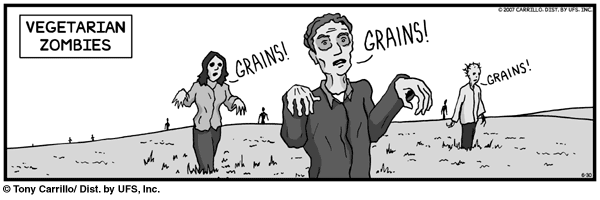
The first is from Jim who asks, “If someone is a vegetarian in their pre-zombie state would they refrain from meat? And along the same vein could a zombie be able to recognise nuts and berries as food and survive on non-meat products?”


A famous slogan of vegetarianism is “nothing with a face”, and if fiction has taught us anything, it’s that Zombie’s love nothing more than sucking and tucking into a human’s face.

Vegetarianism comes in many forms, some eat eggs, but no other dairy products, and vegans exclude all animal products including clothing such as leather. There are various reasons people abide by these diets, it might be part of their religious practice or for moral reasons but ultimately it is an active choice.

Our current research indicates that a Zombie’s diet stems from the disease affecting an area of the brain known as the hypothalamus. 


The hypothalamus helps regulate appetite by letting us know when we are hungry, or reversely, full. Dysfunction in this region can make us feel like we are never full, causing us to continually eat. This is called hyperphagia. We believe that a Zombie would be hyperphagic and therefore be compelled to eat continuously.

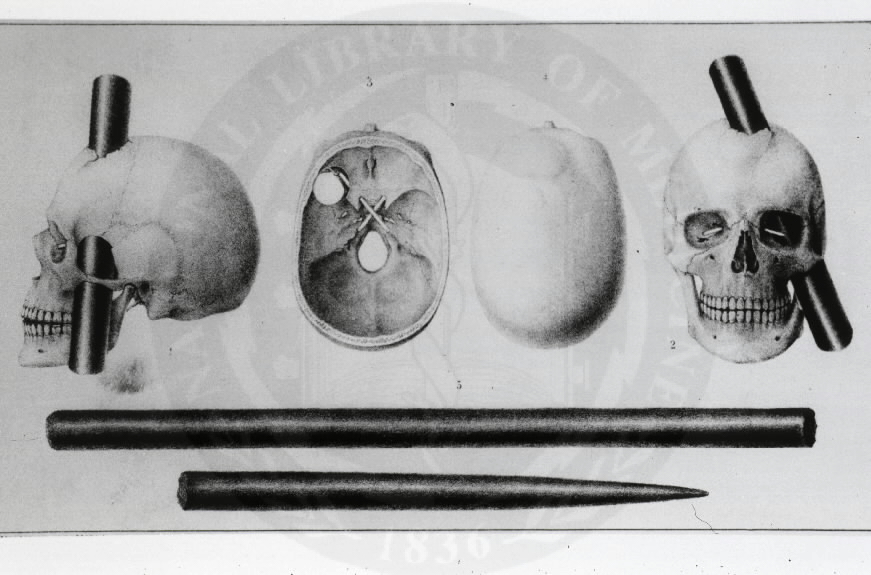
Areas of the brain also play a role in moral sensitivity. In the 19th century a man named Phineas Gage was involved in an accident. An iron bar was blasted through his head, damaging the frontal lobe of his brain and severely changing his personality. Prior to his accident Phineas was a calm mild mannered man, afterward he became an angry womaniser. By studying Gage scientists learned much about the brain, and that the damaged areas were partly responsible for moral sensitivity.

Phineas had great difficulty finding suitable hats after the accident
We must also consider that the Zombie disease is likely to affect a person’s memories, and personality.

If we combine all of these factors it is unlikely that a vegetarian who subsequently becomes a Zombie could remember their previous diet choices, nor care about maintaining them - on top of this the burning compulsion to eat would lead them to devour anything that is available, including meat.

To answer the second part of Jim’s question, could Zombies survive on non-meat products, our current theories indicate that they could and would. A real Zombie, unlike a movie version, does not have a purely cannibalistic diet, and has similar nutritional requirements to a regular human. Read more about our theories in this handy online guide: http://www.zombiescience.co.uk/#!vstc0=zombieism-guide       

In conclusion, a pre-Zombie vegetarian would not carry on this dietary choice once infected, and would be happy to eat anything from meat to veg.
Our second question today comes in from Nico who wants to know, “Do you think its possible for zombies to become useful members of society? For example get jobs etc.”

Of course in some professions no one would notice a difference
The answer to this depends on whether we could develop a treatment for Zombieism that would remove the disease, and whether we could then repair the damage it leaves behind.

If we could do both then Zombies would essentially be human again and able to return to their previous lives.

If we could do neither it would be more difficult, as we’d need to ensure we kept the disease contained and therefore keep infected people away from the uninfected.

If we could remove the disease, but not repair the damage, a Zombie could be left with significant brain injuries leading to difficulties ranging from movement problems to aggression issues. However the human brain is capable of rewiring itself in a process known as neuroplasticity. The aforementioned Phineas Gage overcame many of his initial personality problems over time. So the longer a disease free Zombie lived, the greater the chance it’s brain has of resolving any problems.

Advert for 'In the Flesh'


The television series ‘In the Flesh’ (http://en.wikipedia.org/wiki/In_the_Flesh_(TV_series)) examined this scenario with fantastic creativity, and if you haven’t seen it, I’d recommend you check it out.

So in answer to Nico’s question, I’d optimistically say that yes Zombie’s could become useful members of society. It might take some time for treatments and cures to be developed but we’d never simply give up on helping our fellow humans. Eventually we’d find a way.

A big thank you to Jim and Nico for today’s questions. As always I can answer your questions right here on the ZomBlog. Why not leave yours as a comment below? Or visit our Book of Faces (www.facebook.com/zombiescience) and ask your question there.

No matter how gruesome or tricky, or trickily gruesome, I’ll endeavour to answer them.

Have a Zom-tastic day students,

Doctor Austin

Doctor Austin ZITS BSz MSz DPep, is a Theoretical Zombiologist and Head of the Zombie Institute for Theoretical Studies at the University of Glasgow, Scotland UK.



Wednesday, 21 August 2013

Zombieism: Eat, Sex, Poop

Hello there Zombiology Student, it’s great to have you with us at the ZomBlog.

Today we have a terrific trio of Zombie Science questions from some of our students.

First off we have Ida who asks, “Do zombies have a functional digestive system, and do they defecate?”

I love human, but it goes straight through me.
Let’s begin with the first part. In fiction Zombies have a continual craving for human flesh, yet they are said to not require nourishment. Regular visitors will know that here at the Institute we have a different idea of what a real Zombie would be like. First off, we don’t believe Zombies would be ‘undead’ but rather human beings suffering from a disease. Humans have to ingest certain materials which the digestive system processes and turns into energy in order for us to survive . Zombies move around, so they must be using some form of energy. In order to get this energy their bodies must be processing what they eat, therefore they will need to have a functional digestive system.

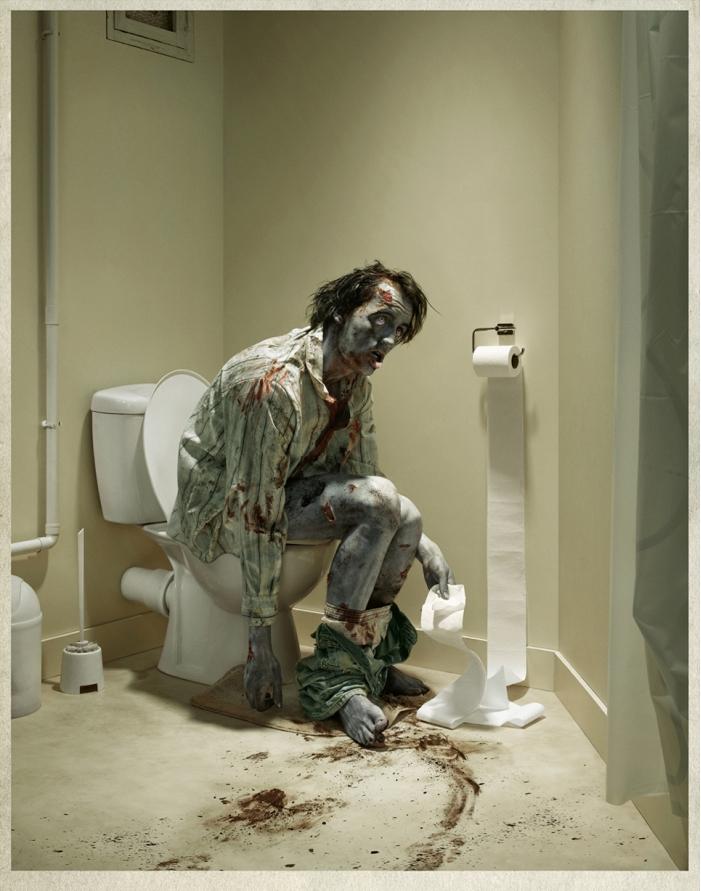
But do they defecate? Defecation is the last part of the digestion process whereby solid, semi-solid, or liquid waste is eliminated from the digestive tract via the anus. As we have established, Zombies are using their digestive systems and to use an old adage ‘what comes in must go out’. However, the damage a Zombie disease would do to a human brain could cause changes in behaviour. So don’t expect a Zombie to excuse themselves to the bathroom. They’d likely go wherever and whenever they needed to, we should count ourselves lucky that TV and Film has yet to develop smell-o-vision.

Except this Zombie, he has standards.
Next up is Paul who wanted to know, “Can they mate or bear children?”

The answer depends on how we approach the question. A Zombie disease that is spread by biting, akin to Rabies, is contained within saliva and transferred by a bite. The disease increases aggression raising the Zombie’s chances of biting someone, spreading the disease, and therefore creating infected Zombie offspring. So from that perspective, yes they can in a way create more Zombies.

However I believe Paul’s question really relates to whether a human with Zombieism could have intercourse and produce a child the ‘old fashioned way’.

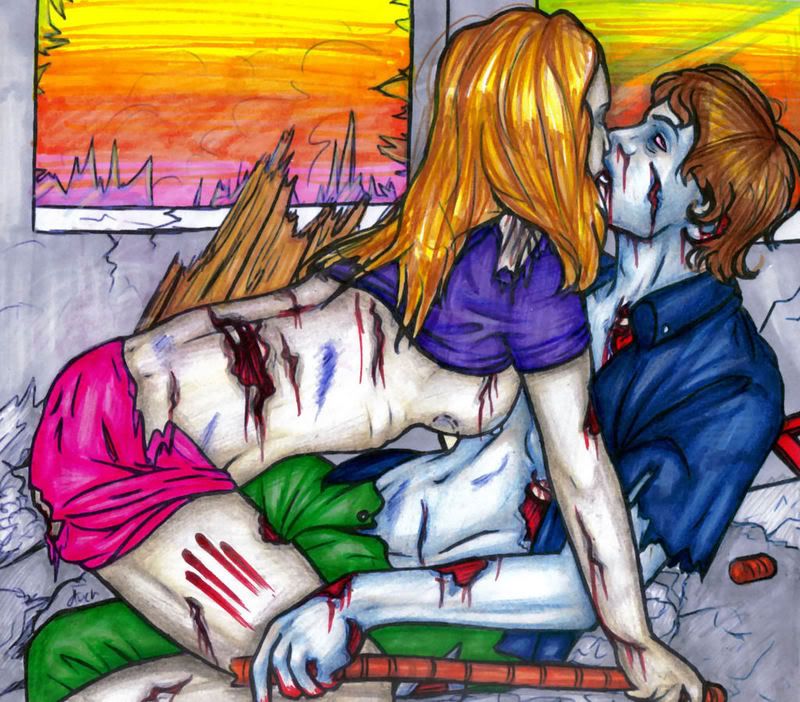
This was the only appropriate 'Zombie Sex' image I could find. I saw things students, things I'll never be able to un-see. 


Surprisingly we have not conducted much research into Zombie Sex. Although in a previous ZomBlog we did answer the question, “If a Zombie bites a pregnant woman, would the baby become infected?” (http://zomblogofficial.blogspot.co.uk/2011/07/babies-first-bite.html)

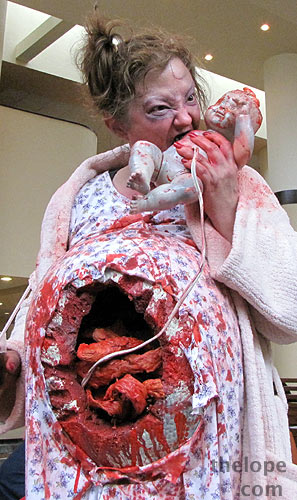
We believe that a Zombie disease would be affecting the human brain in a variety of ways, affecting memories and altering their personalities. This could mean that a Zombie may not be interested in sex, nor able to recall how to do it. Yet there is nothing to say that the biological facilities required to create a baby would be non-functional. If two Zombies did make love, it would be an instinctive behaviour, much like when two animals go at it in the wild. Of course the Zombie’s wouldn’t have hospitals, midwives, and so on. So if a Zombie did become pregnant, once she came to term the baby would simply drop out and without the proper care it is unlikely to survive for long.

A Zombie giving birth is essentially a packed lunch.
Lastly Colin asked, “Why don’t zombies feed on each other in a frenzy?”

This is a question that many have asked when watching Zombie films. A possibility may be that a Zombie is capable of sensing the Zombieism disease by smell, and therefore avoids it in favour of non-infected food. There are countless stories of animals such as dogs and cats being able to detect disease in humans. But, these animals have far superior smelling abilities than humans so it seems unlikely that a Zombie would have such a skill.

Did you hear that World War Z?


Another idea is that the disease may be altering their behaviour in such a way to discourage them from infecting those who already have the disease. There are many parasites who alter their hosts behaviour. When the malaria parasite plasmodium infects a mosquito it initially makes them more cautious and less likely to bite. This provides time for the disease to reproduce in their guts. Afterwards it makes them bite more frequently, and for longer, increasing odds the parasite will spread. Yet once a human becomes infected they give off signals that attract more mosquitoes.

At present we could hypothesize that a Zombie disease is in some way discouraging infected hosts from biting those who are infected. A reason for this would be because its aim is to spread the disease, and to do that it makes more sense to bite someone who is uninfected. But we would need to learn a lot more about Zombieism to provide a definitive answer. This is what makes studying Zombieism so exciting - the unanswered questions!   

My thanks to Ida, Paul, and Colin for their brilliant questions - I hope you are satisfied with the answers.

If you have a question about the undead please get in touch with me in the comments section below, and don’t forget to visit our Book of Faces (www.facebook.com/zombiescience). I’m ready, waiting, and willing to answer your questions right here on the ZomBlog.

Remember in the fight against Zombies the greatest weapon is knowledge, and crossbows, but mainly knowledge.

Doctor Austin

Doctor Austin ZITS BSz MSz DPep, is a Theoretical Zombiologist and Head of the Zombie Institute for Theoretical Studies at the University of Glasgow, Scotland UK.


Wednesday, 24 July 2013

Walking Corpse Syndrome

Hello Zombiology Students and a warm welcome to the ZomBlog.

Today we're looking at Walking Corpse Syndrome, also known as Cotard's Syndrome. This rare mental condition causes people to believe they are dead, putrefying and missing internal organs - essentially Zombieism of the mind.

You have a medical licence right?

Cotard's Syndrome takes its name from French Neurologist Jules Cotard who encountered a patient named, Mademoiselle X (perhaps a relation of Professor X). Mademoiselle X claimed to have no brain, no nerves, no chest, no stomach, and no intestines. She also believed she was immortal and therefore didn't need to eat. She died of starvation.

"I ain't related to no French Bird Bro. They don't even have a word for entrepreneur."

The condition is usually found in patients suffering from depression and schizophrenia - leading many Doctors to see it as a component of these illnesses.

More recently a patient, known only as Graham, was identified with the syndrome. Graham believed his brain had died. Neurologists Adam Zeman at the University of Exeter, UK, and Steven Laureys at the University of Liège in Belgium, met with Graham and took scans of his brain. The type of scan they carried out is called positron emission tomography (PET) and is used to produce detailed, three-dimensional images of the inside of the body. Before being scanned the patient has a radioactive substance passed into their body. The substance gives off gamma waves (a type of radiation) that can be detected by the scanner. The scans taken of Graham were the first ever conducted on someone with Cotard's Syndrome.

A PET Scan. Or maybe this is a CAT Scan. I get them confused.

What they discovered was amazing. The activity in certain areas of his brain was so low it was comparable to someone in a vegetative state.

Laureys explained,

I've been analysing PET scans for 15 years and I've never seen anyone who was on his feet, who was interacting with people, with such an abnormal scan result. Graham's brain function resembles that of someone during anaesthesia or sleep. Seeing this pattern in someone who is awake is quite unique to my knowledge.

Adam Zeman continued, "It seems plausible that the reduced metabolism was giving him this altered experience of the world, and affecting his ability to reason about it."

The condition caused Graham to completely withdraw into himself. He found no pleasure in anything, he stopped eating, speaking and even brushing his teeth. This caused his teeth to turn black, further compounding his feelings that he was dead.

After lengthy psychotherapy and drug treatment Graham gradually recovered. There have been reports that using antidepressants, antipsychotics and mood stabilizers combined with traditional talking therapies have helped those who suffer from the illness.

With being such a rare condition, research into this mysterious syndrome is very limited. Could it be that when Zombies do appear the disease affecting them will induce such a syndrome? Only time will tell.

Keep up your studies and join me again next time for more science behind the undead here on the ZomBlog.

Best wishes,

Doctor Austin

Doctor Austin ZITS BSz MSz DPep, is a Theoretical Zombiologist and Head of the Zombie Institute for Theoretical Studies at the University of Glasgow, Scotland UK.

Left: Doctor Austin Right: HRH The Queen

Monday, 4 February 2013

Are Zombies Real?

A warm welcome to all of you fine Zombiology Students.

As I travel the UK delivering our new tutorial Zombie Science: Worst Case Scenario I find myself regularly being asked one question in particular, ‘are Zombies real?’

Whilst this question may seem to evoke a simple yes or no answer, it is actually a little more complicated than that.


I hope it's a yes, otherwise I'll be looking pretty stupid right now...
Certainly the Zombies (dead human bodies reanimated with an unending desire to consume flesh and the ability to transform those they bite) that populate the world of television, films, comics and games do not presently exist in the real world.

However that doesn’t preclude them from ever existing. There are many agents capable of causing disease including viruses, bacteria, parasites and rogue prions. Whilst none of these produce all the symptoms found in a fictional Zombie it is important to remember that these agents are always changing.

Think for a moment of the flu. We’ve all had it at least once, but it’s far more likely you’ve had it several times. It is caused by the influenza virus, and like Lady Gaga it’s always changing. As with all living things the virus makes small mistakes, called mutations, each time it reproduces. In every generation there are slight differences and overtime these differences build up. The fancy term for this process in ‘antigenic drift’ and this is why scientists have to continually update and change flu vaccines, to try and keep up with changes in the virus.


From this example we can see how a virus can change. Who is to say that at some point in the future a virus might change enough to produce an illness that matches the fictional version of Zombieism?

Now remember, I said this wasn’t a simple question.

Zombies are real and do exist, there’s even a law banning them from being created – although they’re not like those you’ve seen on the silver screen.

Don’t believe me? Then let’s travel to the Caribbean country of Haiti, as ethnobotanist Wade Davis did over 25 years ago. Here we find a deeply spiritual culture with a deep belief in the existence of Zombies – albeit far from the Zombies of Romero or Kirkman.

Let’s say you’re Haitian and you’ve got a family dispute. Perhaps your brother borrowed your wife, or your Gran keeps asking you to explain the internet – how do you resolve it? Simple, get the local sorcerer to turn them into a Zombie slave – problem solved!
To the Bingo? Eh, yeah, of course we are Gran.
That’s precisely what is believed to have occurred there as Wade Davis discovered. Through meetings with these sorcerers (known as Bokors) Davis managed to acquire samples of their Zombie powder. Analysis revealed the presence of a range of substances including one in particular; Tetrodotoxin. Found in species of puffer fish this toxin is one of the deadliest poisons known to humanity. However if administered in small doses it doesn’t cause death but rather gives one the appearance of being dead via paralysis, the slowing down of body functions, and the like.


Now which one is the Zombie Powder and which one is the Paprika?
The Bokor would place the Zombie powder in an unsuspecting victim’s shoes, down their back or generally anywhere where it would come in contact with the skin, nose, and throat. The victim would appear to progress toward death, eventually fooling people that they were indeed dead, and be buried.   

The Bokor and his minions would then exhume the victim and feed them another concoction designed to keep them somewhat ‘out of it’, so that they wouldn’t attempt to escape or talk back. Many claim these Zombies were then put to work as slaves, but how useful they’d be in performing even a basic task is debateable.   
As I mentioned earlier, creating a Zombie in Haiti is illegal, as article 246 of the Haitian penal code states:


It shall also be qualified as attempted murder the employment which may be made against any person of substances which, without causing actual death, produce a lethargic coma more or less prolonged. If, after the person had been buried, the act shall be considered murder no matter what result follows.

So as we have seen, ‘are Zombies real?’ is a hard question to answer, but I’ll try and make it as simple as possible. The answer is yes, and no.

If you want to know anything about the real science behind Zombies, do send your questions in to info@zombiescience.co.uk or post them in our Book of Faces (www.facebook.com/zombiescience).

Just remember to stay on good terms with your family if you ever find yourself in Haiti,

Doctor Austin

Doctor Austin ZITS BSz MSz DPep, is a Theoretical Zombiologist and Head of the Zombie Institute for Theoretical Studies at the University of Glasgow, Scotland UK.
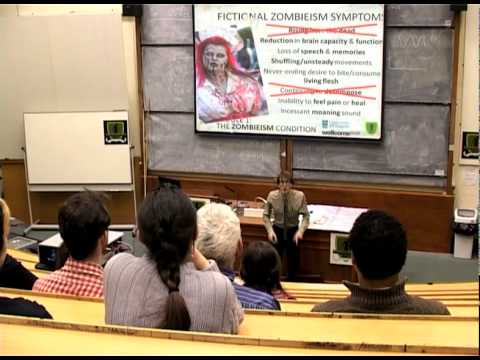
See the Zombie Science: Worst Case Scenario tutorial –

Brighton Science Festival 2013:
Date: Sunday 10th February 2013
Times: 5.30pm & 7.30pm
Venue: Sallis Benney Theatre, 58-67 Grand Parade, Brighton, BN2 0JY
Tickets: Visit Brighton Science Festival’s Official Website 


Glasgow International Comedy Festival
Date: Monday 18th March 2013
Time: 7.30pm
Venue: The Stand Comedy Club, Woodlands Road, Glasgow, Scotland
Tickets: Visit the festival’s official website