Showing posts with label undead. Show all posts

Wednesday, 28 August 2013

The Zombie Scale

A good day to you fine Zombiology Student, come on in and make yourself comfortable.

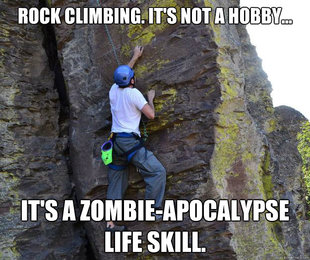
In our ZomBlog today we’re answering a question posed by Chris who wanted to know, “Can zombies rock climb?”

This Zombie is on the fence

Rock climbing is a challenging but extremely fun activity. In the inevitable Zombie Apocalypse it may be reassuring to know you can simply ascend to safety and take up residence in a cave, holding weekend dinner parties with Bigfoot.

But this reassurance may be shattered if the undead can simply shimmy up after you.

Let’s first find out what it physically takes for us humans to climb.

I'm guessing a strong sphincter is one thing
Studies have shown that the average elite male climber is around 5 foot 8 inches, and weighs about 65 kgs. Muscular endurance is important, as you often have to hold your hand in a single position whilst your body moves. What makes climbing rather physiologically unique is that it requires sustained and intermittent contraction of the forearm muscles for upward propulsion. A good climber will generally have a small frame, low body fat, a high level of upper body strength, a reasonable balance of strength between their arms, and a high endurance factor.

Let’s compare that with the physicality of a human suffering from the Zombieism condition.

The areas of the brain known as the cerebellum and basal ganglia are imperative for physical movement, and would likely be affected by Zombieism. Damage to the cerebellum would prevent a Zombie from tuning and refining their movements. This would make conducting the careful and deliberate motions for climbing very difficult.


The basal ganglia helps us select the correct movement in a particular situation. Damage here would prevent the Zombie from actively choosing say, to move it’s hand over moving it’s leg. You can now imagine how this might affect one’s ability to climb.

Furthermore the cerebellum helps us to keep the image our eye’s are seeing still when we turn our head. If it is damaged the image will appear to slip, making it difficult to keep focus on a particular spot such as an important hand hold required for climbing.

So the answer to Chris’ question, “can Zombies rock climb” , is thankfully, no. The disease robs them of the skills required to undertake such a task. When the outbreak begins, rock climbers can simply scale their way up to safety, kick back with Bigfoot and watch the world burn below.


I’m always seeking questions to answer here on the ZomBlog. Why not leave yours as a comment below? Or visit our Book of Faces (www.facebook.com/zombiescience) and ask your question there.

I’m here for all your undead knowledge needs.

Many thanks to Chris for today’s question, and I’ll see you next time, unless you’re out at a rock climbing lesson!

Doctor Austin

Doctor Austin ZITS BSz MSz DPep, is a Theoretical Zombiologist and Head of the Zombie Institute for Theoretical Studies at the University of Glasgow, Scotland UK.


Wednesday, 21 August 2013

Zombieism: Eat, Sex, Poop

Hello there Zombiology Student, it’s great to have you with us at the ZomBlog.

Today we have a terrific trio of Zombie Science questions from some of our students.

First off we have Ida who asks, “Do zombies have a functional digestive system, and do they defecate?”

I love human, but it goes straight through me.
Let’s begin with the first part. In fiction Zombies have a continual craving for human flesh, yet they are said to not require nourishment. Regular visitors will know that here at the Institute we have a different idea of what a real Zombie would be like. First off, we don’t believe Zombies would be ‘undead’ but rather human beings suffering from a disease. Humans have to ingest certain materials which the digestive system processes and turns into energy in order for us to survive . Zombies move around, so they must be using some form of energy. In order to get this energy their bodies must be processing what they eat, therefore they will need to have a functional digestive system.

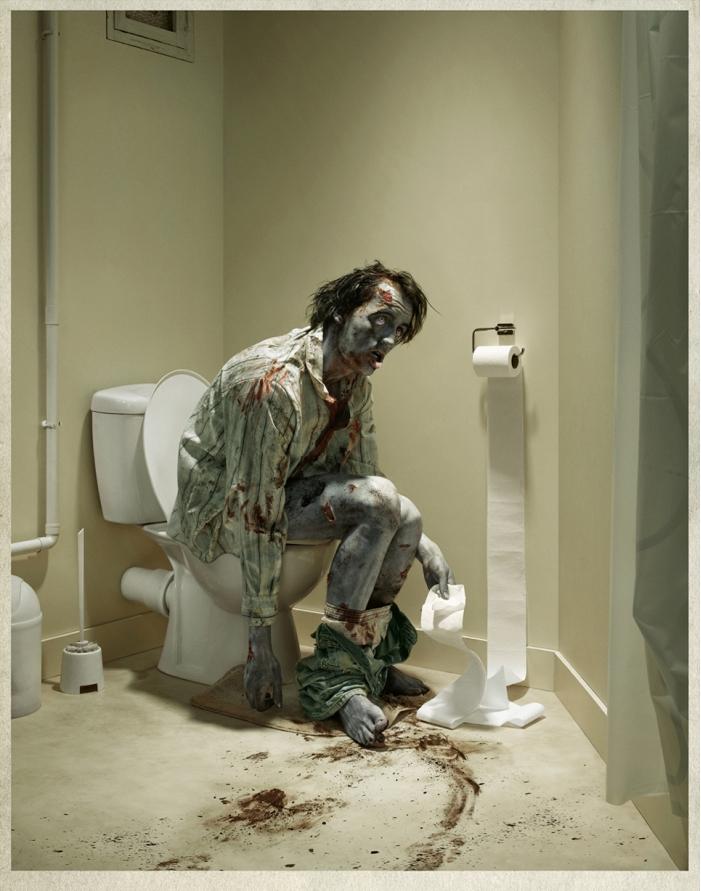
But do they defecate? Defecation is the last part of the digestion process whereby solid, semi-solid, or liquid waste is eliminated from the digestive tract via the anus. As we have established, Zombies are using their digestive systems and to use an old adage ‘what comes in must go out’. However, the damage a Zombie disease would do to a human brain could cause changes in behaviour. So don’t expect a Zombie to excuse themselves to the bathroom. They’d likely go wherever and whenever they needed to, we should count ourselves lucky that TV and Film has yet to develop smell-o-vision.

Except this Zombie, he has standards.
Next up is Paul who wanted to know, “Can they mate or bear children?”

The answer depends on how we approach the question. A Zombie disease that is spread by biting, akin to Rabies, is contained within saliva and transferred by a bite. The disease increases aggression raising the Zombie’s chances of biting someone, spreading the disease, and therefore creating infected Zombie offspring. So from that perspective, yes they can in a way create more Zombies.

However I believe Paul’s question really relates to whether a human with Zombieism could have intercourse and produce a child the ‘old fashioned way’.

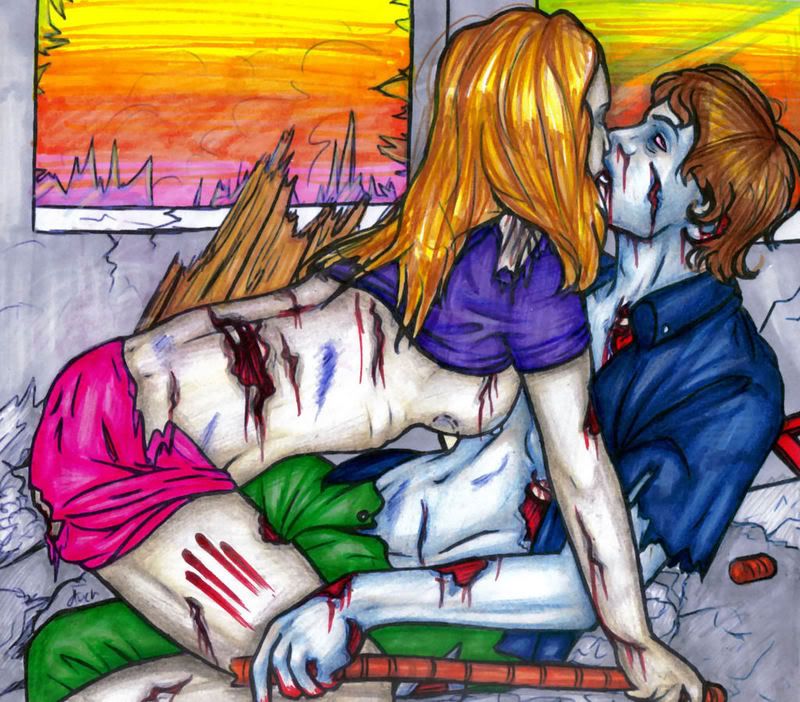
This was the only appropriate 'Zombie Sex' image I could find. I saw things students, things I'll never be able to un-see. 


Surprisingly we have not conducted much research into Zombie Sex. Although in a previous ZomBlog we did answer the question, “If a Zombie bites a pregnant woman, would the baby become infected?” (http://zomblogofficial.blogspot.co.uk/2011/07/babies-first-bite.html)

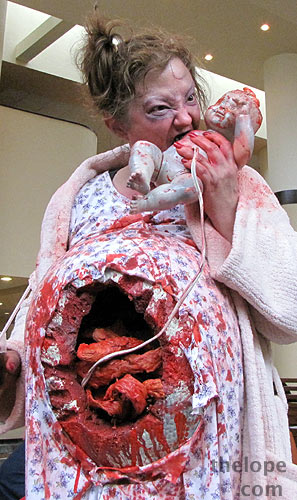
We believe that a Zombie disease would be affecting the human brain in a variety of ways, affecting memories and altering their personalities. This could mean that a Zombie may not be interested in sex, nor able to recall how to do it. Yet there is nothing to say that the biological facilities required to create a baby would be non-functional. If two Zombies did make love, it would be an instinctive behaviour, much like when two animals go at it in the wild. Of course the Zombie’s wouldn’t have hospitals, midwives, and so on. So if a Zombie did become pregnant, once she came to term the baby would simply drop out and without the proper care it is unlikely to survive for long.

A Zombie giving birth is essentially a packed lunch.
Lastly Colin asked, “Why don’t zombies feed on each other in a frenzy?”

This is a question that many have asked when watching Zombie films. A possibility may be that a Zombie is capable of sensing the Zombieism disease by smell, and therefore avoids it in favour of non-infected food. There are countless stories of animals such as dogs and cats being able to detect disease in humans. But, these animals have far superior smelling abilities than humans so it seems unlikely that a Zombie would have such a skill.

Did you hear that World War Z?


Another idea is that the disease may be altering their behaviour in such a way to discourage them from infecting those who already have the disease. There are many parasites who alter their hosts behaviour. When the malaria parasite plasmodium infects a mosquito it initially makes them more cautious and less likely to bite. This provides time for the disease to reproduce in their guts. Afterwards it makes them bite more frequently, and for longer, increasing odds the parasite will spread. Yet once a human becomes infected they give off signals that attract more mosquitoes.

At present we could hypothesize that a Zombie disease is in some way discouraging infected hosts from biting those who are infected. A reason for this would be because its aim is to spread the disease, and to do that it makes more sense to bite someone who is uninfected. But we would need to learn a lot more about Zombieism to provide a definitive answer. This is what makes studying Zombieism so exciting - the unanswered questions!   

My thanks to Ida, Paul, and Colin for their brilliant questions - I hope you are satisfied with the answers.

If you have a question about the undead please get in touch with me in the comments section below, and don’t forget to visit our Book of Faces (www.facebook.com/zombiescience). I’m ready, waiting, and willing to answer your questions right here on the ZomBlog.

Remember in the fight against Zombies the greatest weapon is knowledge, and crossbows, but mainly knowledge.

Doctor Austin

Doctor Austin ZITS BSz MSz DPep, is a Theoretical Zombiologist and Head of the Zombie Institute for Theoretical Studies at the University of Glasgow, Scotland UK.


Wednesday, 7 August 2013

Zombies - Sick Zombies

Greetings Zombiology Students and a hearty welcome to the ZomBlog.

Today’s question came in from John, he asked ‘can Zombies get sick?’


Regular readers will know that our version of Zombies here at the Institute are based on genuine science, rather than fiction. So there are many differences between our idea of a Zombie and those you might encounter on the silver screen.

Presently it is not possible to have a dead body that acts as though it were living. Our current theories dictate that Zombies are not undead but they are human beings who are suffering from a disease. Therefore they will still have beating hearts, a need to eat, breathe and expel waste. The Zombie disease will cause them to be very aggressive, eating continually (controversially not just human flesh - but anything), walk with unsteady shambling movements, and communicate only through a deathly moan. Whatever causes this disease, be it a virus, bacterium, or prion disease, it will be a serious, horrific illness.

The cat based meme is also a strong contender. 
But as John asks, could Zombies get sick?

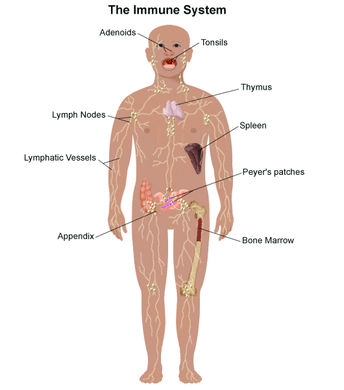
All of us have a guardian against getting ill, our immune system. The immune system is our defender from infectious invaders. Through something called an immune response, the immune system attacks organisms and substances that enter our body to try and damage our vital systems or cause disease.
The immune system, as portrayed by a terrifying drawing.
A network of cells, tissues and organs make up the immune system. The important cells are the white blood cells, also known as leukocytes. They come in two basic types; phagocytes, which, much like a Zombie, chew up invading organisms, and lymphocytes, cells that allow the body to remember and recognize previous invaders and help the body destroy them.
When foreign substances enter our body (called antigens), many cells work together to spot them, and try to get rid of them. They do this by triggering the creation of antibodies, special proteins that lock on to the invaders. Once they’ve been created, they stay in the body, ready to strike again should the disease return. This is why once you get sick with something like chicken pox it is unlikely you’ll get ill from it again.
There are diseases that can affect the immune system. One of the most well known is HIV (human immunodeficiency virus) infection / AIDS (acquired immunodeficiency syndrome). This disease gradually destroys the immune system. Without any defence the body is vulnerable to a multitude of organisms which can easily cause life threatening infections in AIDS patients.
Whatever is causing Zombieism it will be a very invasive disease and is likely to weaken the immune system. On top of this a Zombie’s diet is unlikely to be balanced. They are simply eating anything and everything they can. It is doubtful they’ll be garnishing all the required nutrients that help the body fight off germs. Poor hygiene will also play a role. After all I seriously doubt that a Zombie will take the time to wash its hands after eating or going to the bathroom (if indeed they go to a bathroom, they probably go wherever and whenever they want).
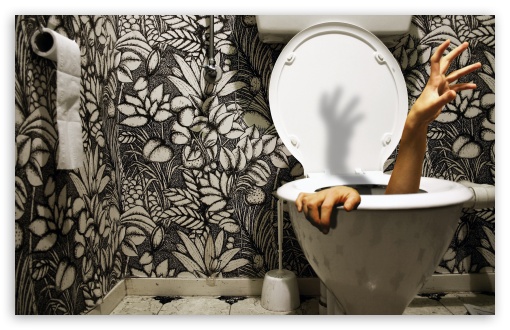
I believe they call this a 'mercy flush'.
Combining all these factors together and a Zombie is going to be an easy target for every illness out there. So the answer to John’s question, can Zombies get sick, has got to be a firm yes. Not only can they get sick, they’re at much greater risk than the rest of us. Hence biological warfare may offer a defence against the apocalypse. But here at the Zombie Institute we always recommend trying to help treat and cure Zombies, rather than trying to kill them! Always remember that Zombies are people too.
If you have a question about the undead please get in touch with me in the comments section below, and don’t forget to visit our Book of Faces (www.facebook.com/zombiescience). I’m ready, waiting, and willing to answer your questions right here on the ZomBlog.

Stay safe students,

Doctor Austin

Doctor Austin ZITS BSz MSz DPep, is a Theoretical Zombiologist and Head of the Zombie Institute for Theoretical Studies at the University of Glasgow, Scotland UK.


Wednesday, 24 July 2013

Walking Corpse Syndrome

Hello Zombiology Students and a warm welcome to the ZomBlog.

Today we're looking at Walking Corpse Syndrome, also known as Cotard's Syndrome. This rare mental condition causes people to believe they are dead, putrefying and missing internal organs - essentially Zombieism of the mind.

You have a medical licence right?

Cotard's Syndrome takes its name from French Neurologist Jules Cotard who encountered a patient named, Mademoiselle X (perhaps a relation of Professor X). Mademoiselle X claimed to have no brain, no nerves, no chest, no stomach, and no intestines. She also believed she was immortal and therefore didn't need to eat. She died of starvation.

"I ain't related to no French Bird Bro. They don't even have a word for entrepreneur."

The condition is usually found in patients suffering from depression and schizophrenia - leading many Doctors to see it as a component of these illnesses.

More recently a patient, known only as Graham, was identified with the syndrome. Graham believed his brain had died. Neurologists Adam Zeman at the University of Exeter, UK, and Steven Laureys at the University of Liège in Belgium, met with Graham and took scans of his brain. The type of scan they carried out is called positron emission tomography (PET) and is used to produce detailed, three-dimensional images of the inside of the body. Before being scanned the patient has a radioactive substance passed into their body. The substance gives off gamma waves (a type of radiation) that can be detected by the scanner. The scans taken of Graham were the first ever conducted on someone with Cotard's Syndrome.

A PET Scan. Or maybe this is a CAT Scan. I get them confused.

What they discovered was amazing. The activity in certain areas of his brain was so low it was comparable to someone in a vegetative state.

Laureys explained,

I've been analysing PET scans for 15 years and I've never seen anyone who was on his feet, who was interacting with people, with such an abnormal scan result. Graham's brain function resembles that of someone during anaesthesia or sleep. Seeing this pattern in someone who is awake is quite unique to my knowledge.

Adam Zeman continued, "It seems plausible that the reduced metabolism was giving him this altered experience of the world, and affecting his ability to reason about it."

The condition caused Graham to completely withdraw into himself. He found no pleasure in anything, he stopped eating, speaking and even brushing his teeth. This caused his teeth to turn black, further compounding his feelings that he was dead.

After lengthy psychotherapy and drug treatment Graham gradually recovered. There have been reports that using antidepressants, antipsychotics and mood stabilizers combined with traditional talking therapies have helped those who suffer from the illness.

With being such a rare condition, research into this mysterious syndrome is very limited. Could it be that when Zombies do appear the disease affecting them will induce such a syndrome? Only time will tell.

Keep up your studies and join me again next time for more science behind the undead here on the ZomBlog.

Best wishes,

Doctor Austin

Doctor Austin ZITS BSz MSz DPep, is a Theoretical Zombiologist and Head of the Zombie Institute for Theoretical Studies at the University of Glasgow, Scotland UK.

Left: Doctor Austin Right: HRH The Queen

Friday, 9 November 2012

Zombies versus Vampires

Welcome back Zombiology Students,

It’s a busy time here at the Zombie Institute. We’ve just finished developing a brand new tutorial Worst Case Scenario that premiered at the London Horror Festival during Halloween. Right now our team are organising a UK tour so do keep your eyes peeled for that. This has meant I’ve had less time to write articles for the ZomBlog, but I’m making up for it now by finally completing this Zombies versus Vampires blog to which many of you contributed your thoughts.  


As you’re no doubt aware this year saw countless news stories appearing relating to cannibalistic attacks. These stories have inspired the term ‘Zombie Summer’ and are almost always cited as being indicative of Zombies, leading many to believe that a Zombie outbreak is in progress, or at the very least, building up steam. In a previous blog I discussed this, and to reiterate, they are not Zombie-like at all. However, whilst talking with my friends at the Zombie Shop, they made an interesting point, “...was there an influx of 'real' vampire attacks after the release of 'Interview with a [sic] Vampire'?”

Before we start, can I get you a drink? No. Wait. I meant something to eat. Damn it! It's the Murdoch interview all over again!
Has the prevalence of the Zombie genre (e.g. The Walking Dead, Zombie events, walks, etc) caused reporters to become obsessed, and see Zombies everywhere? If so, why hasn’t the Twilight series created a similar pattern for Vampires? Or as Zombie Shop point out, did Anne Rice’s Interview with the Vampire evoke such a response when it was published, or again when adapted as film?

It’s important to state here that I am not examining ‘real’ Vampire stories, those that pertain to describe the exploits of a mythical being who feeds on blood. I for one am not an expert in Vampirology. I am merely looking for news stories that attribute unusual assaults/murders to Vampires, or set these stories in that context.

Interview with the Vampire was published in 1976, and the later film adaption in 1994. During my research I couldn’t locate many reports of Vampire-like attacks following either of these periods.

This may be due to the lack of Internet, it was a simpler time, where not every news story was posted online and kept available until the end of the universe. However, in 1998, 22 year old Joshua Rudiger ran around the streets of San Francisco slashing homeless victim’s throats and drinking their blood. He claimed to be a 2,000 year old Vampire, and a Samurai.  

There are a wide range of such stories available in the 21st century, amazingly some very recent stories are far more extreme than that of the Miami Cannibal. Yet we haven’t seemed to have heard of them.

Take the case in Florida of Josephine Smith, a 22 year old woman. In September 2011 she viciously attacked an elderly homeless man, biting chunks of flesh from his face, lips, and arms. Her final words before beginning the assault were, “I am a vampire, I am going to eat you.” When arrested Smith claimed to have no recollection of the attack. This story is very similar to the recent Miami Cannibal case. The victim in both instances was a homeless person, both involved biting, and both attackers carried out the attack naked. Yet this story apparently failed to capture the public’s eye. Smith wasn’t even deemed worthy of her own nickname as the ‘Florida Vampire’ or even ‘Bitey Lady’.

And this is by no means the only one;

May, 2006: A 15 year old girl attacked three classmates in New York, slashing their throats, biting them, and attempting to drink their blood. The ‘vampire’ was charged with second degree assault as a minor and released. Read in full: http://www.metro.co.uk/weird/12547-vampire-girl-attacks-classmates

December, 2010: A 20 year old in Alabama attempted to burn a ‘V’ into a teenager’s forehead, the arresting Detective described him as, “a want-to-be vampire”. Read in full: 

August, 2011: An 18 year old man appeared in court accused of, amongst other things, cutting young woman, biting them, and telling them he was a vampire. Read in full:

August, 2011: A 19 year old Texas man, who claimed to be a 500 year old vampire (from Hell), broke into a woman’s apartment and bit her, then fled shouting that he, “didn’t want to have to feed on humans”. Read in full:

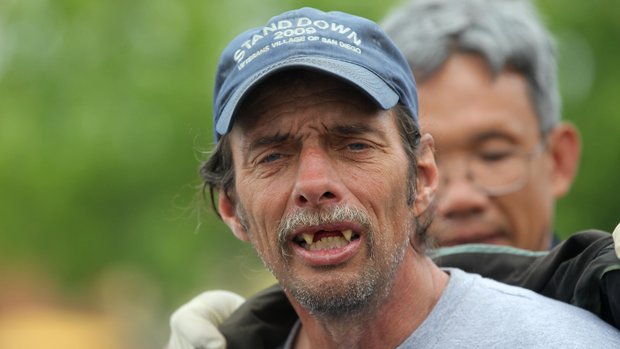
June, 2012: A San Diego man with ‘vampire teeth’ was arrested for attacking a 55 year old homeless man. Read in full:

I'm often mistaken for R-Patz
June, 2012: In Denver a woman was arrested after attacking two people in a convenience store, groping and biting one man, then biting the female cashier. Read in full:

A notable difference between these stories and their Zombie counterparts is tone. When reading the Vampire stories it’s obvious that they don’t paint the ‘Vampire’ as being real, but rather as an (often) disturbed person. Yet many of the Zombie articles cite the incidents as being clear proof that a Zombie is real and that a ‘Zombie Apocalypse’ is beginning.       

A fellow Zombie researcher, Louise, had an interesting perspective:

Eating human flesh, particularly the face, in public places is a bit more terrifying than draining blood in public. Plus, those acting like 'zombies' seem unconscious of what they're doing, whereas the 'vampires' are probably very conscious of their actions ... which, to me, make it a little more scary.

Another student of mine, Mike, had this to say:

The main issue is the background of each of the two types of story, vampiric behaviour has always been seen as erotic, personal, and this is why people are attracted to the whole vampire thing due to books and movies. The vampire has lost its ‘darkness’ and is more acceptable now as such the media likes is shock value and that's why the ‘zombie’ stories still loom large in the media. There is nothing sexy about eating someone’s face.

However, fans of the film Zombie Strippers may disagree with the last sentence.  

Ultimately I haven’t determined a single reason as to why assault stories framed as ‘Zombie Attacks’ are more prominent and have a tendency to go wildly viral compared to those described as ‘Vampire Attacks’. But I do like the following idea from one of my top students, Flora, on how we can make the Zombie a more attractive story in the press:

Zombies lack the glamorous image the press likes to promote, but do get the 'shock, horror, yuk' response. Redress the balance by getting Gok to do a zombie make-over, thus making them appear more on-trend and ask Alistair Campbell to do some negative spin about the more gruesome vampire activity, showing them in their worst possible light in a Sunday newspaper expose. Suddenly zombies will be the ones to get the positive headlines and vampires will be so last year they won't get a mention, except in a short disparaging paragraph on page 10.

I'll leave you with this brain tickler from the enigmatic Philosoraptor...


If any of you out there want to know anything about the real science behind zombies, do send your questions to info@zombiescience.co.uk or post them in our Book of Faces (www.facebook.com/zombiescience).

The truth may well be out there,

Doctor Austin

Doctor Austin ZITS BSz MSz DPep, is a Theoretical Zombiologist and Head of the Zombie Institute for Theoretical Studies at the University of Glasgow, Scotland UK.