Showing posts with label CJD. Show all posts

Wednesday, 4 April 2012

Getting a Zombie grip, and maybe a rip

Bottom of Form
Good day Zombiology Students,

The recent exciting series of the Walking Dead has inspired my students to ask a lot of new zombie questions.
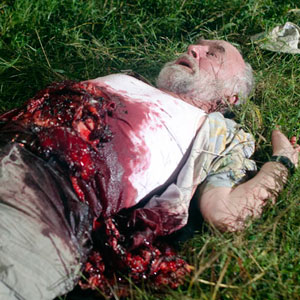
Andrew, an excellent student of mine, asked me this, ‘Are zombies able to tear into someone’s guts with their bare hands? We all know they like to use their teeth but can say Granny Z (that is a zombie with no teeth) uses its hands to tear us into swallow-able pieces? We have already seen zombies have no self-preservation instinct so assuming no atrophy or other degradation of the muscle mass should we not be conscious of the fact that zombies will bring a greater strength to bear as they will not care about injuring themselves? Something any human is capable of (imagine pre-zombie granny Z lifting a car off her grandchild) under particular circumstances’.
I hope the answer is no, but I have my doubts.
Let’s start with the first part, can a human being tear apart another human being bare handed? Well yes, yes they can. As recently as October 2011 a man in Italy tore out his own eyeballs during a Church sermon, and in 2006 a man in the USA lifted a 3,000 pound car to free an injured cyclist. With practice most of us could tear a phone book in half, even if I myself have never managed it.

Success! I can't wait to call my friends, what are there numbers? Oh.
But a person suffering from our proposed Zombieism Prion Disease would be very unsteady on their feet, and have poor control over their limbs. Also, because Zombieism would be a new form of prion disease, it may incorporate the symptoms and characteristics of other current prion diseases. For example Chronic Wasting Disease (CWD), causes amongst other things, extreme weight loss. Although it affects animals at present CWD could develop into part of the new Zombieism Prion Disease. So there is a good chance Zombieism would reduce a person’s strength considerably.

With regard to self-preservation amongst zombies, we certainly see that symptom in the movies, with zombies happily walking through rotor blades on the off chance of getting a snack. In our studies we have concluded that real life zombies would feel pain. The condition congenital insensitivity to pain (CIP), which prevents sufferers feeling the signal of pain, is something one is born with. It cannot be caught like a cold. This condition is the closest comparable one we’ve found to that fictional zombie symptom. CIP is very rare, with only around 100 cases in the USA, so we can bet a real zombie is very unlikely to have that symptom.

No stinkin' helicopter rotor is getting between me and my brunch.
However we know that Zombieism causes a lot of damage to the brain. One area of the brain, the amygdala, is responsible for our instincts. Shaped like an almond, and buried deep with the temporal lobes, it produces much of not only our instincts, but our base emotions as well. If Zombieism caused damage to this area, it may produce a zombie that was overcome with instinct, so much so it may show disregard for pain, even if it was feeling it.

Finally let’s go back to those events, like Andrew’s ‘Granny lifting a car idea’, where people show moments of almost super human strength. In a dangerous situation the human body goes through some interesting changes.

I'll either lift that car, or shoot it off. 
In the brain, the hypothalamus activates, sending a chemical signal adrenal glands. These glands produce adrenalin, which is to the human body, what spinach is to Popeye. When fuelled by adrenalin our muscles are able to contract more. This suddenly gives us the ability to perform actions, like lifting a car, actions we normally couldn’t have managed. Some believe that most of time we only use a small proportion of our strength. When under threat we simply gain the ability to expand on what we already have. But these fits of strength are short lived. Within a few minutes of happening the body begins to return to a more normal state.

It’s a lot like those friends of Captain America, the Six American Warriors, who were given a less refined version of the super solider serum. It gave them Cap’s powers but only for a short time. Inevitably these newly found super powers would give out during a pivotal moment in the plot. On the bright side they do always return during final battles.

The Six American Warriors, well, em, I can name one...
To conclude; zombies do have the potential to tear a human apart. Like humans, when faced with a dangerous situation they may also receive an adrenalin rush, giving them a short burst of enhanced strength. However the Zombieism disease would be badly affecting their ability to move both legs & arms, and may be causing wasting of the body. So they may lack comparable strength to a healthy human.

Ultimately zombies are like fingerprints, each one is different. And just like fingerprints they inevitably end up all over your glass door. No zombie would have the exact same presentation of the disease as another, so some may be more akin to human, and others more akin to demons.

I just washed these you inconsiderate fiends! 
Thank you Andrew for a great question, and if any of you out there want to know anything about the real science behind zombies, do get in touch on info@zombiescience.co.uk.

Best wishes,

Doctor Austin
Doctor Austin ZITS BSz MSz DPep, is a Theoretical Zombiologist and Head of the Zombie Institute for Theoretical Studies at the University of Glasgow, Scotland UK.  

For even more Zombie Science pick up the official Zombie Science book on Amazon now

Sunday, 9 October 2011

Can Zombies Love?


Good Morning/Afternoon/Evening (delete as applicable) Zombiology Students,

This was the most non-explicit image I could find, and I don't recommend typing 'zombie love' into Google Images.
Today's blog is based on a question from John Burns. He asks, 'can zombies fall in love?' I take this to mean with each other, rather than with him, or at least that's what I hope.
This is by no means an easy question. Scientists have been trying for decades to unlock the mysteries of love and, with the exception of Doctor Rohynpnol (whose work is better left unmentioned), they haven't had much luck.

Excluding my ex-wife, the human brain is the most complex thing currently known of in our universe.
Doctor Austin with his ex-wife Mrs Doctor Austin
Many people say it functions like a powerful computer, but even this isn't an accurate comparison, because we can't yet build a computer that works like our brains.
Similarly it is hard to say that one part of the brain is responsible for just one function. Movement for example is controlled and regulated by many different parts of the brain, not just one.

Recent studies of people going through different types of love seems to bear this out as well.
'Brain regions with decidedly unromantic names, like the dorsolateral middle frontal gyrus and the anterior cingulate, as well chemicals like nerve growth factor, dopamine and oxytocin, are all involved in orchestrating these feelings of love.' (Dobson, 2010)

The human brain in love, or playing Call of Duty, I get diagrams easily confused
Dopamine, a neurotransmitter I've nicknamed 'Brain Crack', is thought to be prime player in love. Known for producing a variety of positive feelings dopamine has shown some interesting qualities during animal tests.  

'When a female prairie vole was paired with a male, dopamine levels went up 50 per cent. Levels of oxytocin, (the so-called "cuddle hormone", released in response to stimuli including skin-to-skin contact) likewise go up, as do levels of vasopressin, both promoting relationship bonding. When the female vole was injected with a drug that blocks the activity of dopamine, she lost interest in him.' (Dobson, 2010)

Now we know a little more about what love is doing in the brain, let's apply it to our zombies. Here at the Institute we think zombies will most likely be caused by a new type of prion disease, similar to human mad cow disease (vCJD). All prion diseases cause a unique form of 'spongiform' damage to the brain giving it the appearance of a sponge, or block of Swiss cheese. We also predict that Zombieism prion disease will cause a loss of memory and human personality, giving zombies their trademark absentminded attitude and vacant persona.
Spongiformity in the brain, looks like an Aero, but my gosh it doesn't taste like one.
If we combine these assertions together it doesn't paint a very promising picture for zombies falling in love with each other. Ultimately they won't remember what love is nor have the capacity to make it.

So the answer to John's question, 'can zombies fall in love' is no. No they cannot.

The android Data, from Star Trek, also cannot love. Well except in that one episode, but I never saw it.
Rather than leave on a negative I'll instead share with you some more hopeful lyric's from the Zombie Institute's resident songwriter, Aaron Stoquert:

''cause I don't care, I don't care what you look like tonight
I don't care, I don't care, what you feel like tonight
I don't care, I don't care if we're alive tonight
can you stay here throughout the night--be right next to me?' - (Stoquert, 2011)    


Thanks again for your question John, and everyone else keep yours coming in to: info@zombiescience.co.uk  

Best wishes,

Doctor Austin

Doctor Austin ZITS BSz MSz DPep, is a Theoretical Zombiologist and Head of the Zombie Institute for Theoretical Studies at the University of Glasgow, Scotland UK.


See the Zombie Science 1Z lecture live at:

Manchester Science Festival 2011
Tuesday 25th October 2011
International Anthony Burgess Foundation, Engine House, 3 Cambridge St, Manchester, M1 5BY
Times: 11:00, 14:00, 16:00 (11/2/4pm)
Price: Free (must be booked in advance) Ages 13+

Blackwell's Bookshop Oxford
Wednesday 26th October 2011
Info: Doctor Austin will be delivering a public lecture before signing copies of his book alongside Zombie Handbook UK author Sean T Page.
Blackwells Bookshop, Broad St, Oxford, England, OX1 3BQ
Times: 1900 (7pm) Ages 13+

British & European Society for Gene Therapy Conference - Public Engagement Day
Thursday 27th October 2011
Info: Doctor Austin delivers an all new Zombie Science 1G: Gene Therapy lecture on genetics and gene therapy.
The Brighton Centre, Brighton, England
Times: 1300 (1pm)
Price: Free (Just turn up) Ages 13+

Dundee Science Festival 2011
Saturday 29th October 2011
Venue: 13+ Show: Dalhousie Building,          
             University of Dundee, DD1 4HN
             18+ Show: Dundee University              
             Students Union, Carnegie Suite,
             Airlie Place, DD1 4HP
Times: 13+ Show: 1400 (2pm)
            18+ Show: 1900 (7pm)
Price: Free (must be booked in advance)
Click here for the official Festival website & Click here for the Official Site or call (01382) 38 44 13

London Horror Festival 2011
Tuesday 15th November – Thursday 17th November 1930 (7.30pm)
The Courtyard Studio, Bowling Green Walk, 40 Pitfield Street, London, N1 6EU
£12/10
Booking line:  +44 (0) 844 477 1000

Bibliography:

Anon. (2011) Dopamine, Psychology Today, http://www.psychologytoday.com/basics/dopamine accessed on 02/10/2011

Dobson, Roger. (2010) Love on the Brain, Independent on Sunday, http://www.independent.co.uk/news/science/love-on-the-brain-2096672.html accessed on 02/10/2011

Fischetti, Mark. (2011) Your Brain in Love, Scientific American, http://www.scientificamerican.com/article.cfm?id=your-brain-in-love-graphsci accessed on 02/10/2011

Fisher, Helen. (2004) Biology: Your Brain in Love, Time Magazine, http://www.time.com/time/magazine/article/0,9171,993160-1,00.html accessed on 02/10/2011

Ortigue, Stephanie, et al. (2010) Neuroimaging of Love: fMRI Meta-Analysis Evidence toward New Perspectives in Sexual Medicine, The Journal of Sexual Medicine, Volume 7, Issue 11, p.3541 - 3552, http://onlinelibrary.wiley.com/doi/10.1111/j.1743-6109.2010.01999.x/abstract

Stoquert, Aaron. (2011) I'll See You Again, Run for your Life EP, FiveOhfour Entertainment,  [Music Recording]

Tuesday, 2 August 2011

Zombie Bludgeoning & You


Fit’ like Zombiology students,

Doc A lecturing on prion disease
I had the pleasure of delivering my Zombie Science lecture as part of the Wrexham Science Festival in Wales. Afterwards I was asked a most intriguing question by one of my students, Ms Flora Cat:

“What would I need to use to effectively clean up potentially (prion disease) infected material? I can double glove, but I don’t think I have a strong enough cleaner.”

Regular students will know that we believe zombies will be caused by a prion disease, similar to Creutzfeldt-Jakob disease (CJD). But what you might not know is that these prion diseases, as well as being hard to treat, are even harder to clean up.  CJD is a good example for us to use here because it comes in many forms. You will most likely have heard of variant Creutzfeldt-Jakob disease (vCJD), often called human mad cow disease, the kind believed to have been caused by people eating meat infected with mad cow disease. 

Another type is Iatrogenic CJD (iCJD). This is caused by healthcare-associated transmission, (i.e. patients for whom contaminated medical equipment was used or who received contaminated transplants.) Only two cases of this have ever been proven (but more cases are suspected). They involved electrodes that had been placed in a CJD patient’s brain. Once used for this they were properly sterilized and used again, only to transmit the CJD to new patients. After this was suspected to be happening the same electrodes were placed in a chimpanzee’s brain. The chimp also caught CJD and the link was proven.

It is important to note that only certain parts of the body seem to transmit CJD. Areas like the brain, spinal cord and eye have the highest infectious risk. Areas including saliva and bone marrow carry no infectious risk at all. Furthermore some people have contracted iCJD through blood transfusions from infected donors. Never accept donated blood from a zombie, not even if he offers you a biscuit.

I picked the wrong day to wear 3D glasses...
So if CJD and other prion diseases have a resistance to standard cleaning procedures what options are available to help those working in healthcare to fully disinfect their equipment?

Well, prions and prion diseases are notoriously mysterious and unusual in the science world. Methods to disinfect and sterilize them over the past few years have been controversial and cautious. What is clear is that many traditional methods are ineffective for sterilization. Methods like boiling, using dry heat or UV light for example.

But it isn’t doom and gloom because some methods, under certain circumstances, do work. A standard way to sterilize equipment is using a device called an autoclave. An autoclave is like a medical dishwasher that uses high pressure saturated steam to clean objects. Used on certain settings it can inactivate infectious prions to a safe level.
An autoclave - great for sterilizing things & getting the brown out of trousers
However the same process could be found to be ineffective due to differing prion concentrations, exposure time, temperature or a multitude of other factors.

But this applies mainly to those of us working medically with prion infected zombies. What about our Flora’s question? If you’ve just bludgeoned a zombie’s skull in and spread infectious brains all over the shop, what should you do?

Well here at the Zombie Institute we recommend a policy of avoidance in regard to those infected. Further to that we discourage violence, it should only be used as a last resort and only if you are in mortal danger. But let’s say theoretically that isn’t possible, zombies are surrounding you, threatening to bite your family, and the only solution is skull smashing. Here is the ZITS Guide to Safe Practice:

What are you moaning for? I'm the one who has to walk home alone.
  • Pick an out of the way, secure location to beat up your zombie. This should be somewhere that is only used for zombie slaying (e.g. not in your bedroom). That way you can ensure the infectious stuff stays there.
  • Gloves (doubling optional) should be worn for handling blood and body fluids. If you anticipate your zombie being a squirter add in some gowns, masks and protective eyewear. Don’t forget to keep this kit in your location and always leave it there. No popping it on for parties when you can’t be bothered creating a Halloween costume.
  • Select a suitable tool (e.g. giant mallet) for the bludgeoning procedure, use it only for prion zombie beatings, and keep it in your selected location. This avoids cross contamination. (I.e. forking a zombie to death then using the same fork to eat a pot noodle = very bad) Ideally you really only want to use a weapon once then have it destroyed. This might not be possible with available resources, but try and be creative. The computer game Dead Rising provides plenty of inspiration. (E.g. bat + nails = bat with nails, jewels + torch = lightsaber...ok they don’t all work...)
  • To decontaminate surfaces and instruments as well as safely dispose of waste please check out the unexcitedly named but very informative ‘Biosafety Practices for Handling Prions and Prion-Infected Tissues’ paper. (Link in the references)
Dead Rising 2 gives the Laws of Thermodynamics a badly scalded finger
So in conclusion, there are many ways in which you can attempt to clean up prion zombie infected mess. However much of the equipment, chemicals and practical skills are not likely to be in great supply or easily accessible if a zombie outbreak occurs, therefore the best solution is careful avoidance. If unfortunately you are forced to kill a zombie try and use a non-splattering style. Remember unlike fictional zombies real zombies do have to breathe so put down that pick axe and pick a pillow, you’ll quickly find yourself smothering your way to safety.

I ain't paying for a home Mum...ahem...I mean take that Zombie.
Thanks to Flora for her question and remember keep your Zombie Science queries coming our way because in the fight against zombies the greatest weapon is knowledge, and crossbows, but mainly knowledge.

Best wishes,
Doc A

Doctor Austin ZITS BSz MSz DPep is head of the Zombie Institute for Theoretical Studies and Zombiologist Royal to Her Majesty the Queen

See the Zombie Science 1Z Lecture –

Newcastle City Library:
Saturday 21st & Sunday 22nd August 2011
33 New Bridge Street West, Newcastle, England NE1 8AX
Lecture Times: Sat - 1400 & 1600 (2 & 4pm) Sun – 1200 & 1500 (12 & 3pm)
Tickets: Free – must be reserved in advance call 0191 277 4100
Suitable for ages 13+

References:
Rutala W: Guideline for Disinfection and Sterilization of Prion-Contaminated Medical Instruments, 2010 Feb, Infection Control and Hospital Epidemiology (http://www.unc.edu/depts/spice/dis/ICHE-2010-Feb-p107.pdf)
Michigan State University: Recommended Biosafety Practices for Handling Prions and Prion-Infected Tissues, May 2007, Biosafety in Research (http://www.biosafety.msu.edu/current_topic/Prions/working_with_prions.pdf)
CJD Support Network: Iatrogenic CJD Information Sheet 3, Jan 2008

Saturday, 16 July 2011

Babies first bite

Good day Zombiology Students,

Today’s ZomBlog aims to answer a question from a student who attended my lecture during the Brighton Festival Fringe. He asks, “if a pregnant woman is bitten by a zombie, would the baby become infected?”

From a young age Zombie children are able to perform cesarean sections.
Setting aside why someone wants to know that in the first place, we are left with a rather interesting question.

Regular visitors to the blog will know our research focuses on how a prion disease, like mad cow disease, could cause Zombieism. In this blog we’ll look at both prion diseases and viruses.

Many think that vertical transmission from mother to offspring, is one of the ways prion disease spreads among members of the animal kingdom. To confirm if this is the case in humans is far more difficult. 

There has been one potential case of a woman with a prion disease (vCJD) giving birth to a baby that then went on to develop the condition (nvCJD). Scans of the child indicated what appeared to be the characteristic tissue damage in the brain that is seen in all prion diseases, but mother-child transfer was not confirmed.

We're not mad, just eccentric.
One of our leading Zombieism researchers, Dr. Katie White, discusses this further:
“As far as I can work out this hasn't really been proven. I've examined a more recent and reliable article that says of 9 known cases of women with vCJD giving birth, none of their babies have developed CJD (but due to the long time it takes to develop symptoms, they might have the disease but just don’t show symptoms yet). They tried to detect the rogue prion in the placenta, uterus and amniotic fluid of a vCJD patient who gave birth, but they could only detect the normal form of the prion.”    
Doctor Katie hard at work in the Zombie Institute
Let’s now look at viruses. We’ll use our favourite comparison for Zombieism, Rabies. Rabies is a viral disease that is most commonly spread by biting, just like with fictional Zombies. But that’s not the only way it can spread.

In 1981 a nine month pregnant woman entered a Turkish Clinic after having been bitten 32 days earlier by a dog. The following day birth was induced, but the baby died suddenly after 40 hours. Later tests revealed the presence of the rabies virus in both mother and child. This is thought to be one of the first cases of placental transmission.

So to conclude today’s blog, and answer our question, let’s return to Dr. Katie, “If Zombieism is caused by a virus then yes transfer of the disease to the baby is certainly possible. But if it’s caused by a prion then the transfer seems to be a lot less likely. However, knowing that Zombies eat anything, it is most likely that a Zombie mother would probably eat the baby. Therefore I don't think Zombie babies are going to be a very big threat.”

Keep your question’s coming in! Here at the Zombie Institute for Theoretical Studies we’re always happy to answer your science queries on the shuffling superstars of the horror world.    

Best wishes,

Doctor Austin

Doctor Austin ZITS BSz MSz DPep is head of the Zombie Institute for Theoretical Studies and Zombiologist Royal to Her Majesty the Queen

See the Zombie Science 1Z Lecture –
Wrexham Science Festival:
Wednesday 20th July 2011
Glyndŵr University, Wrexham 
Shows: 1400 & 1800 (2 & 6pm) Tickets: Free – must be booked in advance
Suitable for ages 13+ 

References:
Mikrobiyol Bul.: Transplacental rabies in humans, 1985 Apr; 19(2):95-9.
Leake J: Tragedy of baby feared born with nvCJD, 05 Mar 00, Sunday Times
Xiangzhu Xiao, et al: Failure to Detect the Presence of Prions in the Uterine and Gestational Tissues from a Gravida with Creutzfeldt-Jakob Disease, May 2009, The American Journal of Pathology